the/this/who The, the definite article. ὁ, ἡ, τό, the prepositive article ( ἄρθρον προτακτικόν ), originally a demonstr. pron. (so usually in Hom.), in general corresponding to the Eng. definite article. As demonstr. pron. As freq. in Hom., absol., he ( she, it ), his (etc.): Ac 17:28 (quoted from the poet Aratus). Distributive, ὁ μὲν... ὁ δέ, the one... the other: I Co 7:7, Ga 4:22; pl., Ac 14:4, 17:32, Phl 1:16, al.; οἱ μὲν... ἄλλοι δέ, Mt 16:14, Jo 7:12; οἱ μεν̀... ὁ δέ, He 7:21, 23. In narration (without ὁ μὲν preceding), ὁ δέ, but he: Mt 2:14, Mk 1:45, Lk 8:21, Jo 9:38, al. mult. As prepositive article, the, prefixed, to nouns unmodified: ὁ θεός, τὸ φῶς, etc.; to abstract nouns, ἡ σοφία, etc., to pl. nouns which indicate a class, οἱ ἀλώπεκες, foxes, Mt 8:20, al.; to an individual as representing a class, ὁ ἐργάτης, Lk 10:7; c. nom. = voc. in addresses, Mt 11:26, Jo 19:3, Ja 5:1, al.; to things which pertain to one, ἡ χεῖρ, his hand, Mk 3:1; to names of persons well known or already mentioned; usually to names of countries (originally adjectives), ἡ Ἰουδαία, etc. To modified nouns: c. pers. pron. gen., μοῦ, σοῦ, etc.; c. poss. pron., ἐμός, σός, etc.; c. adj. between the art. and the noun, ὁ ἀγαθὸς ἄνθρωπος, Mt 12:35; the noun foll. by adj., both c. art., ὁ ποιμὴν ὁ καλός, Jo 10:11 (on ὁ ὄχλος πολύς, Jo 12:9, v. M, Pr., 84); before adjectival phrases, ἡ κατ’ ἐκλογὴν πρόθεσις, Ro 9:11. To Other parts of speech used as substantives; neuter adjectives: τ. ἀγαθόν, etc.; cardinal numerals: ὁ εἶς, οἷ δύο, etc.; participles: ὁ βαπτίζων (= ὁ Βαπτιστής, Mt 14:2 ), Mk 6:14; πᾶς ὁ, c. ptcp., every one who, etc.; adverbs: τὸ πέραν, τὰ νῦν, ὁ ἔσω ἄνθρωπος; infinitives: nom., τὸ θέλειν, Ro 7:18, al.; gen., τοῦ, after adjectives, ἄξιον τοῦ πορεύεσθαι, I Co 16:4; verbs, ἔλαχεν τοῦ θυμιᾶσαι, Lk 1:9; and freq. in a final sense, ἐξῆλθεν ὁ σπείρειν, Mt 13:3 (on the artic. inf., v. Bl., § 71). In the neut. to sentences, phrases or single words treated as a quotation: τὸ Ἐι δύνῃ, Mk 9:23; τὸ ἔτι ἅπαξ, He 12:27; τὸ ἀνέβη, Eph 4:9, al. To prepositional phrases: οἱ ἀπὸ Ἰταλίας, He 13:24; οἱ ἐκ νόμου, Ro 4:14; neut. acc. absol., in adverbial phrases, τὸ καθ’ ἡμέραν, daily, Lk 11:3; τὸ κατὰ σάρκα, as regards the flesh, Ro 9:5. To nouns in the genitive, denoting kinship, association, etc.: ὁ τοῦ, the son of (unless context indicates a different relationship), Mt 10:2, al.; τὰ τοῦ θεοῦ, the things that pertain to God, Mt 16:23; τὰ τῆς εἰρήνης, Ro 14:19 (cf. M, Pr., 81 ff.; Bl, §§ 46, 47). Scroll for more
from above/again (a) from above, from heaven, (b) from the beginning, from their origin (source), from of old, (c) again, anew. ἄνωθεν adv, (< ἄνω ), from above: ἀπὸ ἄ., Mt 27:51, Mk 15:38; ἐκ τῶν ἄ., Jo 19:28; meaning, from heaven: Jo 3:31 19:11, Ja 1:17 3:15, 17. from the first, from the beginning: Lk 1:3, Ac 26:5; whence anew, again: Jo 3:3, 7, (so most, but v. Meyer, in l.; cf. Field, Notes, 86 f.); πάλιν ἄ., Ga 4:9 (MM, VGT, s.v.).† Scroll for more
to come/go I come, go. ἔρχομαι, [in LXX very freq. for בּוֹא, also for הלךְ ni., אתה, etc., 34 words in all;] to come; of persons, either as arriving or returning from elsewhere: Mt 8:9, Mk 6:31, Lk 7:8, Jo 4:27, Ro 9:9, al.; seq. ἀπό, Mk 5:35 7:1, Jo 3:2, al.; ἐκ, Lk 5:17, Jo 3:31, al.; εἰς, Mk 1:29, al.; διά seq. εἰς, Mk 7:31; ἐν (Cremer, 263 f., but v.s. ἐν ), Ro 15:29, I Co 4:21; ἐπί, c. acc., Mk 6:53 11:13, Jo 19:33, al.; κατά, c. acc., Lk 10:33 Ac 16:7; παρά, c. gen., Lk 8:49; c. acc., Mt 15:29, Mk 9:14, al.; c. dat. comm., incomm. (M, Pr., 75, 245), Mt 21:5, Re 2:5, 16; with adverbs: πόθεν, Jo 3:8, al.; ἄνωθεν, Jo 3:31; ὄπισθεν, Mk 5:27; ὧδε, Mt 8:29; ἐκεῖ, Jo 18:3; ποῦ, He 11:8; seq. ἕως, Lk 4:42; ἄχρι, Ac 11:5; with purpose expressed by inf., Mk 5:14, Lk 1:59, al.; by fut. ptcp., Mt 27:49; ἵνα, Jo 12:9; εἰς τοῦτο, ἵνα, Ac 9:21; διά, c. acc., Jo 12:9; before verbs of action, ἔρχεται καί, ἦλθε καί, etc.: Mk 2:18, Jo 6:15, al.; ἔρχου καὶ ἴδε, Jo 1:47 11:34; ἐλθών (redundant; Dalman, Words, 20 f.), Mt 2:8 8:7, Mk 7:25, Ac 16:39, al.; similarly ἐρχόμενος, Lk 15:25, al.; of coming into public view: esp. of the Messiah ( ὁ ἐρχόμενος, Mt 11:3, al.; v. Cremer, 264), Lk 3:16, Jo 4:25; hence, of Jesus, Mt 11:19, Lk 7:34, Jo 5:43, al.; of the second coming, Mt 10:23, Ac 1:11, I Co 4:5, I Th 5:2, al.; of time: ἔρξονται ἡμέραι (pres. for fut.: Bl., §56, 8), Lk 23:29, He 8:8 (LXX); fut., Mt 9:15, Mk 2:20, al.; ἔρξεται ὥρα, ὅτε, Jo 4:21, 23. al.; ἦλθεν, ἐλήλυθε ἡ ὥρα, Jo 13:1 16:32 17:1; ἡ ἡμέρα τ. κυρίου, I Th 5:2; καιροί, Ac 3:19; of things and events: κατακλυσμός, Lk 17:27; λιμός, Ac 7:11; ἡ ὀργή, I Th 1:10; ὁ λύχνος, Mk 4:21 (v. Swete, in l.). Metaph., τ. ἀγαθά, Ro 3:8; τ. τέλειον, I Co 13:10; ἡ πίστις, Ga 3:23, 25; ἡ ἐντολή, Ro 7:9; with prepositions: ἐκ τ. θλίψεως, Re 7:14; ἐις τ. χεῖρον, Mk 5:26; εἰς πειρασμόν, ib. 14:38, al. to go: ὀπίσω, c. gen. (Heb. הָלַךְ אַחֲרֵי ), Mt 16:24, Mk 8:34, Lk 9:23; σύν, Jo 21:3; ὁδόν, Lk 2:44. (Cf. ἀν-, ἐπ-αν-, ἀπ-, δι-, εἰς, ἐπ-εἰσ-, παρ-εἰσ-, συν-εἰσ-, ἐξ-, δι-εξ-, ἐπ-, κατ-, παρ-, ἀντι-παρ-, περι-, προ-, προσ-, συν-έρχομαι.) SYN.: πορεύομαι, χωρέω (v, Thayer, s.v. ἔρξομαι ). Scroll for more
above (a) adv: on the top, above, (b) prep: on the top of, above, over, on, above, more than, superior to. ἐπ-άνω adv., [in LXX for מַעֲלָה, עַל, מֵעָל, etc.;] above; adverbially; of place: Lk 11:44; of number, more than: Mk 14:5, I Co 15:6. As prep. c. gen.; of place: Mt 2:9 5:14 21:7 23:18, 20, 22 27:37 28:2, Lk 4:39 10:19, Re 6:8 20:3; of pre-eminence: Lk 19:17, 19, Jo 3:31.† Scroll for more
all All, the whole, every kind of. πᾶς, πᾶσα, πᾶν, gen., παντός, πάσης, παντός, [in LXX chiefly for כֹּל;] all, every. As adj., c. subst. anarth., all, every, of every kind: Mt 3:10 4:23, Mk 9:49, Lk 4:37, Jo 2:10, Ac 27:20, Ro 7:8, Re 18:17, al. mult.; pl., all, Ac 22:15, Ro 5:12, He 1:6, al.; of the highest degree, π. ἐξουσία ( προθυμία, χαρά ), Mt 28:18, Ac 17:11, Phl 2:29, al.; also the whole (though in this sense more freq. c. art.), Mt 2:3, Ac 2:36, Ro 11:26. C. art. (before the art., after the noun, or, denoting totality, between the art. and noun), all, whole: Mt 8:32 13:2, Mk 5:33, Lk 1:10, Ac 7:14, Ro 3:19, Ga 5:14, Eph 4:16, al.; pl., Mt 2:4, Mk 4:13, Ro 1:5, al. As pron., masc. and fem., every one: Mk 9:49, Lk 16:16, He 2:9; seq. rel. pron., Mt 7:24, Ac 2:21, Ga 3:10, al.; c. ptcp. (anarth.), Mt 13:19, Lk 11:4; c. ptcp. (c. art.), Mt 5:22, Mk 7:8, Lk 6:47, Jo 3:8, Ro 1:16, al.; pl., πάντες, absol., all, all men, Mt 10:22, Mk 13:13, Lk 20:38, Jo 1:7 3:26, I Co 8:1, al.; οἱ π. (collectively, as a definite whole), Ro 11:32, I Co 1:17, Eph 4:13, al.; π. οἱ ( ὅσοι ), Mt 4:24, Mk 1:32, Lk 4:40, al. Neut., sing., πᾶν, everything, all: πᾶν τό, c. ptcp., I Co 10:25, 27, Eph 5:13, I Jo 2:16 5:4 (sc. ὄν ); πᾶν ὅ, Jo 17:2, Ro 14:23; collectively, of persons (Westc., in l.), Jo 6:37, 39; c. prep., in adverbial phrases, διὰ παντός, always, Mt 18:10, al.; ἐν παντί, in everything, in every way, II Co 4:8, Phi 4:6, al.; pl., πάτνα, all things: absol., Jo 1:3, I Co 2:10, He 2:8, al.; of certain specified things, Mk 4:34, Lk 1:3, Ro 8:28, I Th 5:21, al.; acc., πάντα, adverbially, wholly, in all things, in all respects, Ac 20:35, I Co 9:25, al.; c. art., τὰ π., all things (a totality, as distinct from anarth. πάντα, all things severally; cf. Westc., Eph., 186 f.), absol.: Ro 11:36, I Co 8:6, Eph 3:9, He 1:3, al.; relatively, Mk 4:11, Ac 17:25, Ro 8:32, al.; πάντα τά, c. ptcp., Mt 18:31, al.; πάντα ταῦτα ( ταῦτα π. ), Mt 6:32, 33, al.; πάντα, c. prep, in adverbial phrases, πρὸ πάντων, above all things, Ja 5:12, I Pe 4:8; ἐν π., in all things, in all ways, I Ti 3:11, I Pe 4:11, al.; κατὰ πάντα, in all respects, Ac 17:22, al. C. neg., πᾶς οὐ ( μή ) = οὐδείς, v.s. οὐ and μή, and cf. M, Pr., 245 f. Scroll for more
he is εἰμί, with various uses and significations, like the English verb to be. As substantive verb. Of persons and things, to be, exist: Ac 17:28, Jo 1:1 8:58 17:5, al; ὁ ὢν καὶ ὁ ἦν (for past ptcp.), Re 1:4, 8 4:8 11:17 16:5 (v. Swete, Ap., 5; M, Pr., 228); τὰ (μὴ) ὄντα, Ro 4:17, I Co 1:28. Of times, events, etc., to be, happen, take place: Mt 24:3, Mk 14:2 15:42, Lk 21:23, Jo 4:6, 23 5:10, al. to be present, be in a place, have come: Mt 2:13, 15, Mk 1:45 5:21 15:40, Lk 1:80 5:29, Jo 7:30, al.; seq. εἰς, Mk 2:1; seq. ἐκ, (ἐξ), Mt 1:20 21:25, Mk 11:30, Jo 3:31, al. Impers., ἔστι, ἦν, etc.; there is (Fr. il y a ), was, etc.: Mt 16:28, Lk 16:19, Jo 3:1 5:2, Ro 3:10, al.; c. dat. (of the possessor; Bl., §37, 3), Mt 16:22, Lk 1:7, Jo 18.10, Ro 9:2, al.; ἔστιν ὅς, ὅστις (chiefly in pl), Mt 16:28 19:2, Mk 9:1, al.; c. inf., = ἔξεστιν (q.v.), it is possible: He 9:5, I Co 11:20, RV (but v. ICC, in l.). As copula uniting subject and predicate. Expressing simply identity or equivalence: Mt 5:13 14:15, Lk 1:18, 19, Jo 1:1 4:19, Re 3:9, al. mult. Explicative, as in parable, figure, type, etc.: Mt 13:19, I Co 9:2, 10:4, 11:25, Ga 4:24, Re 17:15, al.; τοῦτ’ ἔστιν, Mt 27:46, Mk 7:2, Ro 7:18 al.; ὅ ἐστιν, Mk 3:17, Col 1:24, He 7:2, al.; akin to this is the sacramental usage: Mt 26:26-28, Mk 14:22, 24, Lk 22:19, I Co 11:24 (v. ICC on Mk, I Co, ll. c.; DB, iii, 148 f.). C. gen.: qual., etc., Mk 5:42, Lk 3:23, I Co 14:33, He 12:11, al.; part., I Ti 1:20, II Ti 1:15; poss., Mt 5:3, 10, Mk 12:7, Lk 4:7; of service or partisanship, Ro 8:9, I Co 1:12, II Co 10:7, II Ti 2:19. C. dat. (BL, §37, 3): Ac 1:8 9:15, Ro 4:12, I Co 1:18 2:14, Re 21:7, al. C. ptcp., as a periphrasis for the simple verb (Bl., §62, 1, 2; M, Pr., 225 ff.); c. ptcp. pf. (cl.): Mt 10:30, Lk 9:32, Jo 3:24, Ac 21:35, I Co 15:19, al; c. ptcp. pr. (esp. in impf., as in Heb. and Aram.; Dalman, Words, 35 f.), Mt 7:29, Mk 1:22, Lk 4:31 14:1, Ac 1:10, al. mult., id. for imper. (M, Pr., 180f., 182f.), with ellipsis of εἰμί, Ro 12:9, 10, He 13:5, al.; c. ptcp. aor. (cl), Lk 23:9. Seq. εἰς (cf. Heb. הָיָה לְ ), a vernac. usage (M, Pr., 71): Mt 19:5, Mk 10:8, He 8:10, al. C. adv.: Mt 19:20, Mk 4:26, Lk 18:11, al. Ellipses; of the copula (Bl., §30, 3): Mt 8:29 24:32, Jo 21:22, 23, He 6:4, al.; of the predicate: ἐγώ εἰμί, Mt 14:27, Mk 6:50, al.; absol. (cf. De 32:39; אֲנִי הוּא ), Mk 13:6, Jo 4:26, al. (cf. ἄπ-, ἔν-, πάρ-, συμ-πάρ-, σύν-ειμι ). Scroll for more
the/this/who The, the definite article. ὁ, ἡ, τό, the prepositive article ( ἄρθρον προτακτικόν ), originally a demonstr. pron. (so usually in Hom.), in general corresponding to the Eng. definite article. As demonstr. pron. As freq. in Hom., absol., he ( she, it ), his (etc.): Ac 17:28 (quoted from the poet Aratus). Distributive, ὁ μὲν... ὁ δέ, the one... the other: I Co 7:7, Ga 4:22; pl., Ac 14:4, 17:32, Phl 1:16, al.; οἱ μὲν... ἄλλοι δέ, Mt 16:14, Jo 7:12; οἱ μεν̀... ὁ δέ, He 7:21, 23. In narration (without ὁ μὲν preceding), ὁ δέ, but he: Mt 2:14, Mk 1:45, Lk 8:21, Jo 9:38, al. mult. As prepositive article, the, prefixed, to nouns unmodified: ὁ θεός, τὸ φῶς, etc.; to abstract nouns, ἡ σοφία, etc., to pl. nouns which indicate a class, οἱ ἀλώπεκες, foxes, Mt 8:20, al.; to an individual as representing a class, ὁ ἐργάτης, Lk 10:7; c. nom. = voc. in addresses, Mt 11:26, Jo 19:3, Ja 5:1, al.; to things which pertain to one, ἡ χεῖρ, his hand, Mk 3:1; to names of persons well known or already mentioned; usually to names of countries (originally adjectives), ἡ Ἰουδαία, etc. To modified nouns: c. pers. pron. gen., μοῦ, σοῦ, etc.; c. poss. pron., ἐμός, σός, etc.; c. adj. between the art. and the noun, ὁ ἀγαθὸς ἄνθρωπος, Mt 12:35; the noun foll. by adj., both c. art., ὁ ποιμὴν ὁ καλός, Jo 10:11 (on ὁ ὄχλος πολύς, Jo 12:9, v. M, Pr., 84); before adjectival phrases, ἡ κατ’ ἐκλογὴν πρόθεσις, Ro 9:11. To Other parts of speech used as substantives; neuter adjectives: τ. ἀγαθόν, etc.; cardinal numerals: ὁ εἶς, οἷ δύο, etc.; participles: ὁ βαπτίζων (= ὁ Βαπτιστής, Mt 14:2 ), Mk 6:14; πᾶς ὁ, c. ptcp., every one who, etc.; adverbs: τὸ πέραν, τὰ νῦν, ὁ ἔσω ἄνθρωπος; infinitives: nom., τὸ θέλειν, Ro 7:18, al.; gen., τοῦ, after adjectives, ἄξιον τοῦ πορεύεσθαι, I Co 16:4; verbs, ἔλαχεν τοῦ θυμιᾶσαι, Lk 1:9; and freq. in a final sense, ἐξῆλθεν ὁ σπείρειν, Mt 13:3 (on the artic. inf., v. Bl., § 71). In the neut. to sentences, phrases or single words treated as a quotation: τὸ Ἐι δύνῃ, Mk 9:23; τὸ ἔτι ἅπαξ, He 12:27; τὸ ἀνέβη, Eph 4:9, al. To prepositional phrases: οἱ ἀπὸ Ἰταλίας, He 13:24; οἱ ἐκ νόμου, Ro 4:14; neut. acc. absol., in adverbial phrases, τὸ καθ’ ἡμέραν, daily, Lk 11:3; τὸ κατὰ σάρκα, as regards the flesh, Ro 9:5. To nouns in the genitive, denoting kinship, association, etc.: ὁ τοῦ, the son of (unless context indicates a different relationship), Mt 10:2, al.; τὰ τοῦ θεοῦ, the things that pertain to God, Mt 16:23; τὰ τῆς εἰρήνης, Ro 14:19 (cf. M, Pr., 81 ff.; Bl, §§ 46, 47). Scroll for more
being εἰμί, with various uses and significations, like the English verb to be. As substantive verb. Of persons and things, to be, exist: Ac 17:28, Jo 1:1 8:58 17:5, al; ὁ ὢν καὶ ὁ ἦν (for past ptcp.), Re 1:4, 8 4:8 11:17 16:5 (v. Swete, Ap., 5; M, Pr., 228); τὰ (μὴ) ὄντα, Ro 4:17, I Co 1:28. Of times, events, etc., to be, happen, take place: Mt 24:3, Mk 14:2 15:42, Lk 21:23, Jo 4:6, 23 5:10, al. to be present, be in a place, have come: Mt 2:13, 15, Mk 1:45 5:21 15:40, Lk 1:80 5:29, Jo 7:30, al.; seq. εἰς, Mk 2:1; seq. ἐκ, (ἐξ), Mt 1:20 21:25, Mk 11:30, Jo 3:31, al. Impers., ἔστι, ἦν, etc.; there is (Fr. il y a ), was, etc.: Mt 16:28, Lk 16:19, Jo 3:1 5:2, Ro 3:10, al.; c. dat. (of the possessor; Bl., §37, 3), Mt 16:22, Lk 1:7, Jo 18.10, Ro 9:2, al.; ἔστιν ὅς, ὅστις (chiefly in pl), Mt 16:28 19:2, Mk 9:1, al.; c. inf., = ἔξεστιν (q.v.), it is possible: He 9:5, I Co 11:20, RV (but v. ICC, in l.). As copula uniting subject and predicate. Expressing simply identity or equivalence: Mt 5:13 14:15, Lk 1:18, 19, Jo 1:1 4:19, Re 3:9, al. mult. Explicative, as in parable, figure, type, etc.: Mt 13:19, I Co 9:2, 10:4, 11:25, Ga 4:24, Re 17:15, al.; τοῦτ’ ἔστιν, Mt 27:46, Mk 7:2, Ro 7:18 al.; ὅ ἐστιν, Mk 3:17, Col 1:24, He 7:2, al.; akin to this is the sacramental usage: Mt 26:26-28, Mk 14:22, 24, Lk 22:19, I Co 11:24 (v. ICC on Mk, I Co, ll. c.; DB, iii, 148 f.). C. gen.: qual., etc., Mk 5:42, Lk 3:23, I Co 14:33, He 12:11, al.; part., I Ti 1:20, II Ti 1:15; poss., Mt 5:3, 10, Mk 12:7, Lk 4:7; of service or partisanship, Ro 8:9, I Co 1:12, II Co 10:7, II Ti 2:19. C. dat. (BL, §37, 3): Ac 1:8 9:15, Ro 4:12, I Co 1:18 2:14, Re 21:7, al. C. ptcp., as a periphrasis for the simple verb (Bl., §62, 1, 2; M, Pr., 225 ff.); c. ptcp. pf. (cl.): Mt 10:30, Lk 9:32, Jo 3:24, Ac 21:35, I Co 15:19, al; c. ptcp. pr. (esp. in impf., as in Heb. and Aram.; Dalman, Words, 35 f.), Mt 7:29, Mk 1:22, Lk 4:31 14:1, Ac 1:10, al. mult., id. for imper. (M, Pr., 180f., 182f.), with ellipsis of εἰμί, Ro 12:9, 10, He 13:5, al.; c. ptcp. aor. (cl), Lk 23:9. Seq. εἰς (cf. Heb. הָיָה לְ ), a vernac. usage (M, Pr., 71): Mt 19:5, Mk 10:8, He 8:10, al. C. adv.: Mt 19:20, Mk 4:26, Lk 18:11, al. Ellipses; of the copula (Bl., §30, 3): Mt 8:29 24:32, Jo 21:22, 23, He 6:4, al.; of the predicate: ἐγώ εἰμί, Mt 14:27, Mk 6:50, al.; absol. (cf. De 32:39; אֲנִי הוּא ), Mk 13:6, Jo 4:26, al. (cf. ἄπ-, ἔν-, πάρ-, συμ-πάρ-, σύν-ειμι ). Scroll for more
out from From out, out from among, from, suggesting from the interior outwards. ἐκ ( ἐξ ), prep. c. gen., from out of, from ( see Addendum, p. 492). This entry is included here, but in the print version the entry is found on p. 492. ἐκ, before a vowel ἐξ, prep. c. gen., of motion outwards, separation from (opp. to εἰς; = Lat. e, ex ), from out of, from among, from. Of Place, of motion, out of, forth from, off from: Jo 6:31, Ac 9:3, Ga 1:8, al.; esp. after verbs of motion, Mt 8:28 17:9, Mk 1:25 7:28, Jo 1:33 20:1, Ac 12:7, 17 27:30, al.; constr. praeg., σώζειν (διας.) ἐκ, Ju 5, Ac 28:4. Metaph., Mt 7:4, 5, I Pe 2:9; ἐκ τ. χειρός (-ῶν), seq. gen. pers., Lk 1:74, Jo 10:28, 29, 39, Ac 12:4 24:7, Re 19:2; πίνειν (q.v.) ἐκ; of the place from which an action proceeds, Lk 5:3 (cf. 12:36, Jo 13:4, II Co 2:4 ). Of change from one place or condition to another: Jo 8:42, Ro 6:13 13:11, Re 7:14, al.; c. ellips. of verb of motion, II Ti 2:26, II Pe 2:21, Re 2:21, al. Of separation or distinction from a number, before collective or pl. nouns: Mt 13:47, 49, Jo 12:1, Ac 3:15, I Pe 1:3, al.; after εἷς, Mt 10:29, Lk 17:15, al.; οὐδείς, Jo 7:19, al.; πολλοί, Jo 11:19, al.; τις, Lk 11:15, al.; τίς, Mt 6:27, al.; in partitive phrase as subject of sentence, Jo 16:17; Hebraistically, ἐκ μέσου seq. gen., = ἐκ (Heb. מִתֹּוךְ ), Mt 13:49, al. Of position or direction (so in cl. = ἔξω ): ἐκ δεξιῶν (v.s. δεξιός ); ἐξ ἐναντίας, Mk 15:39 (metaph., Tit 2:8 ); ἐκ ῥιζῶν (i.e., utterly ), Mt 11:20. Of Time, of the point of time from which, from, since: ἐκ γενετῆς, Jo 9:1, cf. Mk 10:20, Lk 23:8, Ac 24:10, al. Of succession in time: ἐκ δευτέρου, a second time, Mk 14:72, al., cf. Mt 26:44; ἡμέραν ἐξ ἡμέρας, from day to day, II Pe 2:8. Of Origin, of nativity, lineage, race: κοίτην (ἐν γαστρί) ἔχειν, Ro 9:10, Mt 1:18; γεννᾶν ἐκ, Mt 1:3 ff.; γεννᾶσθαι (γίνεσθαι) ἐκ, Jo 3:6 8:41, Ga 4:4; ἐκ πνεύματος (θεοῦ), Jo 1:13 3:5 ff., al. ἔρχεσθαι, εἶναι, etc., ἐκ τ. πολέως, Jo 1:44; φυλῆς, Lk 2:36, al.; τ. ἐξουσίας Ἡρῴδου, Lk 23:7; ὁ ὢν ἐκ τ. γῆς, Jo 3:31. Of the author, occasion or source: Mt 5:37, Jo 2:16, Ro 2:29, I Co 8:6, Ga 5:8, al.; ἐκ (τ.) θεοῦ, I Co 7:7, II Co 5:1, I Jo 4:7; ἐκ τ. πατρός, Jo 6:65, al.; ἐκ τ. γῆς ἐστιν, λαλεῖ, Jo 3:31; εκ καρδίας, Ro 6:17, cf. Mk 12:30, I Ti 1:5; ἐκ ψυχῆς, Eph 6:6, Col 3:23; ἐκ πίστεως, Ro 14:23; κρίνειν ἐκ, Lk 19:22, Re 20:12. Of the agent, after passive verbs: Mt 15:5, Mk 7:11, II Co 2:2, al.; freq. in Re after αδικεῖσθαι ( 2:11 ), etc. Of cause, dependence, source of supply: τ. πόνου (των), Re 16:10, 11; τ. φωνῶν, Re 8:13; ἐκ τούτου, Jo 6:66 19:12 (but v. Meyer, in ll.); ἐκ θεοῦ λαλεῖν, II Co 2:17; ἐκ τ. ἀληθείας εἶναι, Jo 18:37, I Jo 3:19; ὁ ἐκ πίστεως, Ro 3:26 4:16; οἱ (ὄντες) ἐκ περιτομῆς, Ac 11:2, Ro 4:12, Ga 2:12, Col 4:11; πίνειν ἐκ, Mt 26:29, Mk 14:25, Jo 4:13, al.; θερίζειν, Ga 6:8; μετέχειν ἐκ (= partit. gen.), I Co 10:13; c. inf., ἐκ τοῦ ἔχειν, II Co 8:11. Of material: Mt 27:29, Jo 2:15 19:2, Ro 9:21, I Co 11:12, Re 18:12, al.; allied to which is its use of price (= cl. gen.): Mt 27:7, cf. ib. 20:2, Ac 1:18. By attraction = ἐν (cl.): τὰ ἐκ τ. οἰκιας, Mt 24:17; τ. ἐξ αὐτοῦ δύναμιν, Mk 5:30 (v. Field, in l.); ὁ πατὴρ ὁ ἐξ οὐρανοῦ, Lk 11:13. Adverbial phrases: ἐξ ἀνάγκης, II Co 9:7, He 7:12; ἐξ ἰσότητος, II Co 8:13; ἐκ μέρους, I Co 12:27 13:9-12; ἐκ μέτρου, Jo 3:34; ἐκ συμφώνου, I Co 7:5. in composition, ἐκ signifies, procession, removal: ἐκβαίνω, ἐκβάλλω. Opening out, unfolding: ἐκτείνω; metaph., ἐξαγγάλλω. Origin: ἔκγονος. Completeness: ἐξαπορέω (v. M, Pr., 237), ἐκπληρόω, ἐκτελέω. Scroll for more
the/this/who The, the definite article. ὁ, ἡ, τό, the prepositive article ( ἄρθρον προτακτικόν ), originally a demonstr. pron. (so usually in Hom.), in general corresponding to the Eng. definite article. As demonstr. pron. As freq. in Hom., absol., he ( she, it ), his (etc.): Ac 17:28 (quoted from the poet Aratus). Distributive, ὁ μὲν... ὁ δέ, the one... the other: I Co 7:7, Ga 4:22; pl., Ac 14:4, 17:32, Phl 1:16, al.; οἱ μὲν... ἄλλοι δέ, Mt 16:14, Jo 7:12; οἱ μεν̀... ὁ δέ, He 7:21, 23. In narration (without ὁ μὲν preceding), ὁ δέ, but he: Mt 2:14, Mk 1:45, Lk 8:21, Jo 9:38, al. mult. As prepositive article, the, prefixed, to nouns unmodified: ὁ θεός, τὸ φῶς, etc.; to abstract nouns, ἡ σοφία, etc., to pl. nouns which indicate a class, οἱ ἀλώπεκες, foxes, Mt 8:20, al.; to an individual as representing a class, ὁ ἐργάτης, Lk 10:7; c. nom. = voc. in addresses, Mt 11:26, Jo 19:3, Ja 5:1, al.; to things which pertain to one, ἡ χεῖρ, his hand, Mk 3:1; to names of persons well known or already mentioned; usually to names of countries (originally adjectives), ἡ Ἰουδαία, etc. To modified nouns: c. pers. pron. gen., μοῦ, σοῦ, etc.; c. poss. pron., ἐμός, σός, etc.; c. adj. between the art. and the noun, ὁ ἀγαθὸς ἄνθρωπος, Mt 12:35; the noun foll. by adj., both c. art., ὁ ποιμὴν ὁ καλός, Jo 10:11 (on ὁ ὄχλος πολύς, Jo 12:9, v. M, Pr., 84); before adjectival phrases, ἡ κατ’ ἐκλογὴν πρόθεσις, Ro 9:11. To Other parts of speech used as substantives; neuter adjectives: τ. ἀγαθόν, etc.; cardinal numerals: ὁ εἶς, οἷ δύο, etc.; participles: ὁ βαπτίζων (= ὁ Βαπτιστής, Mt 14:2 ), Mk 6:14; πᾶς ὁ, c. ptcp., every one who, etc.; adverbs: τὸ πέραν, τὰ νῦν, ὁ ἔσω ἄνθρωπος; infinitives: nom., τὸ θέλειν, Ro 7:18, al.; gen., τοῦ, after adjectives, ἄξιον τοῦ πορεύεσθαι, I Co 16:4; verbs, ἔλαχεν τοῦ θυμιᾶσαι, Lk 1:9; and freq. in a final sense, ἐξῆλθεν ὁ σπείρειν, Mt 13:3 (on the artic. inf., v. Bl., § 71). In the neut. to sentences, phrases or single words treated as a quotation: τὸ Ἐι δύνῃ, Mk 9:23; τὸ ἔτι ἅπαξ, He 12:27; τὸ ἀνέβη, Eph 4:9, al. To prepositional phrases: οἱ ἀπὸ Ἰταλίας, He 13:24; οἱ ἐκ νόμου, Ro 4:14; neut. acc. absol., in adverbial phrases, τὸ καθ’ ἡμέραν, daily, Lk 11:3; τὸ κατὰ σάρκα, as regards the flesh, Ro 9:5. To nouns in the genitive, denoting kinship, association, etc.: ὁ τοῦ, the son of (unless context indicates a different relationship), Mt 10:2, al.; τὰ τοῦ θεοῦ, the things that pertain to God, Mt 16:23; τὰ τῆς εἰρήνης, Ro 14:19 (cf. M, Pr., 81 ff.; Bl, §§ 46, 47). Scroll for more
earth The earth, soil, land, region, country, inhabitants of a region. γῆ, γῆς, ἡ, [in LXX for אֶרֶץ, אֲדָמָה, etc.;] the earth, world: Lk 21:35, Ac 1:8, He 11:13, Re 3:10, al.; opp. to οὐρανός, Mt 5:18 11:25, Mk 13:27, al. land; opp. to sea or water: Mk 4:1, Lk 5:3, Jo 6:21, al.; as subject to cultivation: Mt 13:5, Mk 4:8, Lk 13:7, He 6:7, al.; the ground: Mt 10:29, Mk 8:6, Lk 24:5, Jo 8:6, al.; a region, country: Lk 4:25, Ro 9:28, Ja 5:17; γῆ Ἰσραήλ, Mt 2:20, 21; Χαλδαίων, Ac 7:4; ἡ Ἰουδαία γῆ, Jo 3:22; c. gen. pers., Ac 7:3. Scroll for more
out from From out, out from among, from, suggesting from the interior outwards. ἐκ ( ἐξ ), prep. c. gen., from out of, from ( see Addendum, p. 492). This entry is included here, but in the print version the entry is found on p. 492. ἐκ, before a vowel ἐξ, prep. c. gen., of motion outwards, separation from (opp. to εἰς; = Lat. e, ex ), from out of, from among, from. Of Place, of motion, out of, forth from, off from: Jo 6:31, Ac 9:3, Ga 1:8, al.; esp. after verbs of motion, Mt 8:28 17:9, Mk 1:25 7:28, Jo 1:33 20:1, Ac 12:7, 17 27:30, al.; constr. praeg., σώζειν (διας.) ἐκ, Ju 5, Ac 28:4. Metaph., Mt 7:4, 5, I Pe 2:9; ἐκ τ. χειρός (-ῶν), seq. gen. pers., Lk 1:74, Jo 10:28, 29, 39, Ac 12:4 24:7, Re 19:2; πίνειν (q.v.) ἐκ; of the place from which an action proceeds, Lk 5:3 (cf. 12:36, Jo 13:4, II Co 2:4 ). Of change from one place or condition to another: Jo 8:42, Ro 6:13 13:11, Re 7:14, al.; c. ellips. of verb of motion, II Ti 2:26, II Pe 2:21, Re 2:21, al. Of separation or distinction from a number, before collective or pl. nouns: Mt 13:47, 49, Jo 12:1, Ac 3:15, I Pe 1:3, al.; after εἷς, Mt 10:29, Lk 17:15, al.; οὐδείς, Jo 7:19, al.; πολλοί, Jo 11:19, al.; τις, Lk 11:15, al.; τίς, Mt 6:27, al.; in partitive phrase as subject of sentence, Jo 16:17; Hebraistically, ἐκ μέσου seq. gen., = ἐκ (Heb. מִתֹּוךְ ), Mt 13:49, al. Of position or direction (so in cl. = ἔξω ): ἐκ δεξιῶν (v.s. δεξιός ); ἐξ ἐναντίας, Mk 15:39 (metaph., Tit 2:8 ); ἐκ ῥιζῶν (i.e., utterly ), Mt 11:20. Of Time, of the point of time from which, from, since: ἐκ γενετῆς, Jo 9:1, cf. Mk 10:20, Lk 23:8, Ac 24:10, al. Of succession in time: ἐκ δευτέρου, a second time, Mk 14:72, al., cf. Mt 26:44; ἡμέραν ἐξ ἡμέρας, from day to day, II Pe 2:8. Of Origin, of nativity, lineage, race: κοίτην (ἐν γαστρί) ἔχειν, Ro 9:10, Mt 1:18; γεννᾶν ἐκ, Mt 1:3 ff.; γεννᾶσθαι (γίνεσθαι) ἐκ, Jo 3:6 8:41, Ga 4:4; ἐκ πνεύματος (θεοῦ), Jo 1:13 3:5 ff., al. ἔρχεσθαι, εἶναι, etc., ἐκ τ. πολέως, Jo 1:44; φυλῆς, Lk 2:36, al.; τ. ἐξουσίας Ἡρῴδου, Lk 23:7; ὁ ὢν ἐκ τ. γῆς, Jo 3:31. Of the author, occasion or source: Mt 5:37, Jo 2:16, Ro 2:29, I Co 8:6, Ga 5:8, al.; ἐκ (τ.) θεοῦ, I Co 7:7, II Co 5:1, I Jo 4:7; ἐκ τ. πατρός, Jo 6:65, al.; ἐκ τ. γῆς ἐστιν, λαλεῖ, Jo 3:31; εκ καρδίας, Ro 6:17, cf. Mk 12:30, I Ti 1:5; ἐκ ψυχῆς, Eph 6:6, Col 3:23; ἐκ πίστεως, Ro 14:23; κρίνειν ἐκ, Lk 19:22, Re 20:12. Of the agent, after passive verbs: Mt 15:5, Mk 7:11, II Co 2:2, al.; freq. in Re after αδικεῖσθαι ( 2:11 ), etc. Of cause, dependence, source of supply: τ. πόνου (των), Re 16:10, 11; τ. φωνῶν, Re 8:13; ἐκ τούτου, Jo 6:66 19:12 (but v. Meyer, in ll.); ἐκ θεοῦ λαλεῖν, II Co 2:17; ἐκ τ. ἀληθείας εἶναι, Jo 18:37, I Jo 3:19; ὁ ἐκ πίστεως, Ro 3:26 4:16; οἱ (ὄντες) ἐκ περιτομῆς, Ac 11:2, Ro 4:12, Ga 2:12, Col 4:11; πίνειν ἐκ, Mt 26:29, Mk 14:25, Jo 4:13, al.; θερίζειν, Ga 6:8; μετέχειν ἐκ (= partit. gen.), I Co 10:13; c. inf., ἐκ τοῦ ἔχειν, II Co 8:11. Of material: Mt 27:29, Jo 2:15 19:2, Ro 9:21, I Co 11:12, Re 18:12, al.; allied to which is its use of price (= cl. gen.): Mt 27:7, cf. ib. 20:2, Ac 1:18. By attraction = ἐν (cl.): τὰ ἐκ τ. οἰκιας, Mt 24:17; τ. ἐξ αὐτοῦ δύναμιν, Mk 5:30 (v. Field, in l.); ὁ πατὴρ ὁ ἐξ οὐρανοῦ, Lk 11:13. Adverbial phrases: ἐξ ἀνάγκης, II Co 9:7, He 7:12; ἐξ ἰσότητος, II Co 8:13; ἐκ μέρους, I Co 12:27 13:9-12; ἐκ μέτρου, Jo 3:34; ἐκ συμφώνου, I Co 7:5. in composition, ἐκ signifies, procession, removal: ἐκβαίνω, ἐκβάλλω. Opening out, unfolding: ἐκτείνω; metaph., ἐξαγγάλλω. Origin: ἔκγονος. Completeness: ἐξαπορέω (v. M, Pr., 237), ἐκπληρόω, ἐκτελέω. Scroll for more
the/this/who The, the definite article. ὁ, ἡ, τό, the prepositive article ( ἄρθρον προτακτικόν ), originally a demonstr. pron. (so usually in Hom.), in general corresponding to the Eng. definite article. As demonstr. pron. As freq. in Hom., absol., he ( she, it ), his (etc.): Ac 17:28 (quoted from the poet Aratus). Distributive, ὁ μὲν... ὁ δέ, the one... the other: I Co 7:7, Ga 4:22; pl., Ac 14:4, 17:32, Phl 1:16, al.; οἱ μὲν... ἄλλοι δέ, Mt 16:14, Jo 7:12; οἱ μεν̀... ὁ δέ, He 7:21, 23. In narration (without ὁ μὲν preceding), ὁ δέ, but he: Mt 2:14, Mk 1:45, Lk 8:21, Jo 9:38, al. mult. As prepositive article, the, prefixed, to nouns unmodified: ὁ θεός, τὸ φῶς, etc.; to abstract nouns, ἡ σοφία, etc., to pl. nouns which indicate a class, οἱ ἀλώπεκες, foxes, Mt 8:20, al.; to an individual as representing a class, ὁ ἐργάτης, Lk 10:7; c. nom. = voc. in addresses, Mt 11:26, Jo 19:3, Ja 5:1, al.; to things which pertain to one, ἡ χεῖρ, his hand, Mk 3:1; to names of persons well known or already mentioned; usually to names of countries (originally adjectives), ἡ Ἰουδαία, etc. To modified nouns: c. pers. pron. gen., μοῦ, σοῦ, etc.; c. poss. pron., ἐμός, σός, etc.; c. adj. between the art. and the noun, ὁ ἀγαθὸς ἄνθρωπος, Mt 12:35; the noun foll. by adj., both c. art., ὁ ποιμὴν ὁ καλός, Jo 10:11 (on ὁ ὄχλος πολύς, Jo 12:9, v. M, Pr., 84); before adjectival phrases, ἡ κατ’ ἐκλογὴν πρόθεσις, Ro 9:11. To Other parts of speech used as substantives; neuter adjectives: τ. ἀγαθόν, etc.; cardinal numerals: ὁ εἶς, οἷ δύο, etc.; participles: ὁ βαπτίζων (= ὁ Βαπτιστής, Mt 14:2 ), Mk 6:14; πᾶς ὁ, c. ptcp., every one who, etc.; adverbs: τὸ πέραν, τὰ νῦν, ὁ ἔσω ἄνθρωπος; infinitives: nom., τὸ θέλειν, Ro 7:18, al.; gen., τοῦ, after adjectives, ἄξιον τοῦ πορεύεσθαι, I Co 16:4; verbs, ἔλαχεν τοῦ θυμιᾶσαι, Lk 1:9; and freq. in a final sense, ἐξῆλθεν ὁ σπείρειν, Mt 13:3 (on the artic. inf., v. Bl., § 71). In the neut. to sentences, phrases or single words treated as a quotation: τὸ Ἐι δύνῃ, Mk 9:23; τὸ ἔτι ἅπαξ, He 12:27; τὸ ἀνέβη, Eph 4:9, al. To prepositional phrases: οἱ ἀπὸ Ἰταλίας, He 13:24; οἱ ἐκ νόμου, Ro 4:14; neut. acc. absol., in adverbial phrases, τὸ καθ’ ἡμέραν, daily, Lk 11:3; τὸ κατὰ σάρκα, as regards the flesh, Ro 9:5. To nouns in the genitive, denoting kinship, association, etc.: ὁ τοῦ, the son of (unless context indicates a different relationship), Mt 10:2, al.; τὰ τοῦ θεοῦ, the things that pertain to God, Mt 16:23; τὰ τῆς εἰρήνης, Ro 14:19 (cf. M, Pr., 81 ff.; Bl, §§ 46, 47). Scroll for more
earth The earth, soil, land, region, country, inhabitants of a region. γῆ, γῆς, ἡ, [in LXX for אֶרֶץ, אֲדָמָה, etc.;] the earth, world: Lk 21:35, Ac 1:8, He 11:13, Re 3:10, al.; opp. to οὐρανός, Mt 5:18 11:25, Mk 13:27, al. land; opp. to sea or water: Mk 4:1, Lk 5:3, Jo 6:21, al.; as subject to cultivation: Mt 13:5, Mk 4:8, Lk 13:7, He 6:7, al.; the ground: Mt 10:29, Mk 8:6, Lk 24:5, Jo 8:6, al.; a region, country: Lk 4:25, Ro 9:28, Ja 5:17; γῆ Ἰσραήλ, Mt 2:20, 21; Χαλδαίων, Ac 7:4; ἡ Ἰουδαία γῆ, Jo 3:22; c. gen. pers., Ac 7:3. Scroll for more
he is εἰμί, with various uses and significations, like the English verb to be. As substantive verb. Of persons and things, to be, exist: Ac 17:28, Jo 1:1 8:58 17:5, al; ὁ ὢν καὶ ὁ ἦν (for past ptcp.), Re 1:4, 8 4:8 11:17 16:5 (v. Swete, Ap., 5; M, Pr., 228); τὰ (μὴ) ὄντα, Ro 4:17, I Co 1:28. Of times, events, etc., to be, happen, take place: Mt 24:3, Mk 14:2 15:42, Lk 21:23, Jo 4:6, 23 5:10, al. to be present, be in a place, have come: Mt 2:13, 15, Mk 1:45 5:21 15:40, Lk 1:80 5:29, Jo 7:30, al.; seq. εἰς, Mk 2:1; seq. ἐκ, (ἐξ), Mt 1:20 21:25, Mk 11:30, Jo 3:31, al. Impers., ἔστι, ἦν, etc.; there is (Fr. il y a ), was, etc.: Mt 16:28, Lk 16:19, Jo 3:1 5:2, Ro 3:10, al.; c. dat. (of the possessor; Bl., §37, 3), Mt 16:22, Lk 1:7, Jo 18.10, Ro 9:2, al.; ἔστιν ὅς, ὅστις (chiefly in pl), Mt 16:28 19:2, Mk 9:1, al.; c. inf., = ἔξεστιν (q.v.), it is possible: He 9:5, I Co 11:20, RV (but v. ICC, in l.). As copula uniting subject and predicate. Expressing simply identity or equivalence: Mt 5:13 14:15, Lk 1:18, 19, Jo 1:1 4:19, Re 3:9, al. mult. Explicative, as in parable, figure, type, etc.: Mt 13:19, I Co 9:2, 10:4, 11:25, Ga 4:24, Re 17:15, al.; τοῦτ’ ἔστιν, Mt 27:46, Mk 7:2, Ro 7:18 al.; ὅ ἐστιν, Mk 3:17, Col 1:24, He 7:2, al.; akin to this is the sacramental usage: Mt 26:26-28, Mk 14:22, 24, Lk 22:19, I Co 11:24 (v. ICC on Mk, I Co, ll. c.; DB, iii, 148 f.). C. gen.: qual., etc., Mk 5:42, Lk 3:23, I Co 14:33, He 12:11, al.; part., I Ti 1:20, II Ti 1:15; poss., Mt 5:3, 10, Mk 12:7, Lk 4:7; of service or partisanship, Ro 8:9, I Co 1:12, II Co 10:7, II Ti 2:19. C. dat. (BL, §37, 3): Ac 1:8 9:15, Ro 4:12, I Co 1:18 2:14, Re 21:7, al. C. ptcp., as a periphrasis for the simple verb (Bl., §62, 1, 2; M, Pr., 225 ff.); c. ptcp. pf. (cl.): Mt 10:30, Lk 9:32, Jo 3:24, Ac 21:35, I Co 15:19, al; c. ptcp. pr. (esp. in impf., as in Heb. and Aram.; Dalman, Words, 35 f.), Mt 7:29, Mk 1:22, Lk 4:31 14:1, Ac 1:10, al. mult., id. for imper. (M, Pr., 180f., 182f.), with ellipsis of εἰμί, Ro 12:9, 10, He 13:5, al.; c. ptcp. aor. (cl), Lk 23:9. Seq. εἰς (cf. Heb. הָיָה לְ ), a vernac. usage (M, Pr., 71): Mt 19:5, Mk 10:8, He 8:10, al. C. adv.: Mt 19:20, Mk 4:26, Lk 18:11, al. Ellipses; of the copula (Bl., §30, 3): Mt 8:29 24:32, Jo 21:22, 23, He 6:4, al.; of the predicate: ἐγώ εἰμί, Mt 14:27, Mk 6:50, al.; absol. (cf. De 32:39; אֲנִי הוּא ), Mk 13:6, Jo 4:26, al. (cf. ἄπ-, ἔν-, πάρ-, συμ-πάρ-, σύν-ειμι ). Scroll for more
and And, even, also, namely. καί, conj., and. Copulative. Connecting single words; in general: Mt 2:18 16:1, Mk 2:15, Lk 8:15, He 1:1, al. mult.; repeated before each of the terms in a series, Mt 23:23, Lk 14:21, Ro 7:12 9:4, al.; connecting numerals (WM, § 37, 4): Jo 2:20, Ac 13:20; joining terms which are not mutually exclusive, as the part with the whole: Mt 8:33 26:59, Mk 16:17, Ac 5:29, al. Connecting clauses and sentences: Mt 3:12, Ac 5:21, al. mult.; esp. where, after the simplicity of the popular language, sentences are paratactically joined (WM, § 60, 3; M, Pr., 12; Deiss., LAE, 128 ff.): Mt 1:21 7:25, Mk 9:5, Jo 10:3, al.; joining affirmative to negative sentences: Lk 3:14, Jo 4:11, III Jo 10; consecutive, and so: Mt 5:15 23:32, He 3:19, al.; after imperatives, Mt 4:19, Lk 7:7, al.; = καίτοι, and yet: Mt 3:14 6:26, Mk 12:12, Lk 18:7 (Field, Notes, 72), I Co 5:2, al.; beginning an apodosis (= Heb. וְ; so sometimes δέ in cl.), then: Lk 2:21 7:12, Ac 1:10; beginning a question (WM, § 53, 3a): Mk 10:26, Lk 10:29, Jo 9:36. Epexegetic, and, and indeed, namely (WM, § 53, 3c): Lk 3:18, Jo 1:16, Ac 23:6, Ro 1:5, I Co 3:5, al. In transition: Mt 4:23, Mk 5:1, 21, Jo 1:19, al.; so, Hebraistically, καὶ ἐγένετο ( וַיְהִי; also ἐγένετο δέ ), Mk 1:9 (cf. Lk 5:1; V. Burton, §§ 357-60; M, Pr., 14, 16). καὶ... καί, both... and (for τε... καί, v.s. τε ); connecting single words: Mt 10:28, Mk 4:41, Ro 11:33, al.; clauses and sentences: Mk 9:13, Jo 7:28, I Co 1:22, al. Adjunctive, also, even, still: Mt 5:39, 40, Mk 2:28, al. mult.; esp. c. pron., adv., etc., Mt 20:4, Jo 7:47, al; ὡς κ., Ac 11:17; καθὼς κ., Ro 15:7; οὕτω κ., Ro 6:11; διὸ κ., Lk 1:35; ὁ κ. (Deiss., BS, 313ff.), Ac 13:9; pleonastically, μετὰ κ.. (Bl., §77, 7; Deiss., BS, 265 f,), Phl 4:3; τί κ., 1 Co 15:29; ἀλλὰ κ., Lk 14:22, Jo 5:18, al.; καίγε (M, Pr., 230; Burton, § 437), Ac 17:27; καίπερ, He 5:8; κ. ἐάν, v.s. ἐάν. Scroll for more
out from From out, out from among, from, suggesting from the interior outwards. ἐκ ( ἐξ ), prep. c. gen., from out of, from ( see Addendum, p. 492). This entry is included here, but in the print version the entry is found on p. 492. ἐκ, before a vowel ἐξ, prep. c. gen., of motion outwards, separation from (opp. to εἰς; = Lat. e, ex ), from out of, from among, from. Of Place, of motion, out of, forth from, off from: Jo 6:31, Ac 9:3, Ga 1:8, al.; esp. after verbs of motion, Mt 8:28 17:9, Mk 1:25 7:28, Jo 1:33 20:1, Ac 12:7, 17 27:30, al.; constr. praeg., σώζειν (διας.) ἐκ, Ju 5, Ac 28:4. Metaph., Mt 7:4, 5, I Pe 2:9; ἐκ τ. χειρός (-ῶν), seq. gen. pers., Lk 1:74, Jo 10:28, 29, 39, Ac 12:4 24:7, Re 19:2; πίνειν (q.v.) ἐκ; of the place from which an action proceeds, Lk 5:3 (cf. 12:36, Jo 13:4, II Co 2:4 ). Of change from one place or condition to another: Jo 8:42, Ro 6:13 13:11, Re 7:14, al.; c. ellips. of verb of motion, II Ti 2:26, II Pe 2:21, Re 2:21, al. Of separation or distinction from a number, before collective or pl. nouns: Mt 13:47, 49, Jo 12:1, Ac 3:15, I Pe 1:3, al.; after εἷς, Mt 10:29, Lk 17:15, al.; οὐδείς, Jo 7:19, al.; πολλοί, Jo 11:19, al.; τις, Lk 11:15, al.; τίς, Mt 6:27, al.; in partitive phrase as subject of sentence, Jo 16:17; Hebraistically, ἐκ μέσου seq. gen., = ἐκ (Heb. מִתֹּוךְ ), Mt 13:49, al. Of position or direction (so in cl. = ἔξω ): ἐκ δεξιῶν (v.s. δεξιός ); ἐξ ἐναντίας, Mk 15:39 (metaph., Tit 2:8 ); ἐκ ῥιζῶν (i.e., utterly ), Mt 11:20. Of Time, of the point of time from which, from, since: ἐκ γενετῆς, Jo 9:1, cf. Mk 10:20, Lk 23:8, Ac 24:10, al. Of succession in time: ἐκ δευτέρου, a second time, Mk 14:72, al., cf. Mt 26:44; ἡμέραν ἐξ ἡμέρας, from day to day, II Pe 2:8. Of Origin, of nativity, lineage, race: κοίτην (ἐν γαστρί) ἔχειν, Ro 9:10, Mt 1:18; γεννᾶν ἐκ, Mt 1:3 ff.; γεννᾶσθαι (γίνεσθαι) ἐκ, Jo 3:6 8:41, Ga 4:4; ἐκ πνεύματος (θεοῦ), Jo 1:13 3:5 ff., al. ἔρχεσθαι, εἶναι, etc., ἐκ τ. πολέως, Jo 1:44; φυλῆς, Lk 2:36, al.; τ. ἐξουσίας Ἡρῴδου, Lk 23:7; ὁ ὢν ἐκ τ. γῆς, Jo 3:31. Of the author, occasion or source: Mt 5:37, Jo 2:16, Ro 2:29, I Co 8:6, Ga 5:8, al.; ἐκ (τ.) θεοῦ, I Co 7:7, II Co 5:1, I Jo 4:7; ἐκ τ. πατρός, Jo 6:65, al.; ἐκ τ. γῆς ἐστιν, λαλεῖ, Jo 3:31; εκ καρδίας, Ro 6:17, cf. Mk 12:30, I Ti 1:5; ἐκ ψυχῆς, Eph 6:6, Col 3:23; ἐκ πίστεως, Ro 14:23; κρίνειν ἐκ, Lk 19:22, Re 20:12. Of the agent, after passive verbs: Mt 15:5, Mk 7:11, II Co 2:2, al.; freq. in Re after αδικεῖσθαι ( 2:11 ), etc. Of cause, dependence, source of supply: τ. πόνου (των), Re 16:10, 11; τ. φωνῶν, Re 8:13; ἐκ τούτου, Jo 6:66 19:12 (but v. Meyer, in ll.); ἐκ θεοῦ λαλεῖν, II Co 2:17; ἐκ τ. ἀληθείας εἶναι, Jo 18:37, I Jo 3:19; ὁ ἐκ πίστεως, Ro 3:26 4:16; οἱ (ὄντες) ἐκ περιτομῆς, Ac 11:2, Ro 4:12, Ga 2:12, Col 4:11; πίνειν ἐκ, Mt 26:29, Mk 14:25, Jo 4:13, al.; θερίζειν, Ga 6:8; μετέχειν ἐκ (= partit. gen.), I Co 10:13; c. inf., ἐκ τοῦ ἔχειν, II Co 8:11. Of material: Mt 27:29, Jo 2:15 19:2, Ro 9:21, I Co 11:12, Re 18:12, al.; allied to which is its use of price (= cl. gen.): Mt 27:7, cf. ib. 20:2, Ac 1:18. By attraction = ἐν (cl.): τὰ ἐκ τ. οἰκιας, Mt 24:17; τ. ἐξ αὐτοῦ δύναμιν, Mk 5:30 (v. Field, in l.); ὁ πατὴρ ὁ ἐξ οὐρανοῦ, Lk 11:13. Adverbial phrases: ἐξ ἀνάγκης, II Co 9:7, He 7:12; ἐξ ἰσότητος, II Co 8:13; ἐκ μέρους, I Co 12:27 13:9-12; ἐκ μέτρου, Jo 3:34; ἐκ συμφώνου, I Co 7:5. in composition, ἐκ signifies, procession, removal: ἐκβαίνω, ἐκβάλλω. Opening out, unfolding: ἐκτείνω; metaph., ἐξαγγάλλω. Origin: ἔκγονος. Completeness: ἐξαπορέω (v. M, Pr., 237), ἐκπληρόω, ἐκτελέω. Scroll for more
the/this/who The, the definite article. ὁ, ἡ, τό, the prepositive article ( ἄρθρον προτακτικόν ), originally a demonstr. pron. (so usually in Hom.), in general corresponding to the Eng. definite article. As demonstr. pron. As freq. in Hom., absol., he ( she, it ), his (etc.): Ac 17:28 (quoted from the poet Aratus). Distributive, ὁ μὲν... ὁ δέ, the one... the other: I Co 7:7, Ga 4:22; pl., Ac 14:4, 17:32, Phl 1:16, al.; οἱ μὲν... ἄλλοι δέ, Mt 16:14, Jo 7:12; οἱ μεν̀... ὁ δέ, He 7:21, 23. In narration (without ὁ μὲν preceding), ὁ δέ, but he: Mt 2:14, Mk 1:45, Lk 8:21, Jo 9:38, al. mult. As prepositive article, the, prefixed, to nouns unmodified: ὁ θεός, τὸ φῶς, etc.; to abstract nouns, ἡ σοφία, etc., to pl. nouns which indicate a class, οἱ ἀλώπεκες, foxes, Mt 8:20, al.; to an individual as representing a class, ὁ ἐργάτης, Lk 10:7; c. nom. = voc. in addresses, Mt 11:26, Jo 19:3, Ja 5:1, al.; to things which pertain to one, ἡ χεῖρ, his hand, Mk 3:1; to names of persons well known or already mentioned; usually to names of countries (originally adjectives), ἡ Ἰουδαία, etc. To modified nouns: c. pers. pron. gen., μοῦ, σοῦ, etc.; c. poss. pron., ἐμός, σός, etc.; c. adj. between the art. and the noun, ὁ ἀγαθὸς ἄνθρωπος, Mt 12:35; the noun foll. by adj., both c. art., ὁ ποιμὴν ὁ καλός, Jo 10:11 (on ὁ ὄχλος πολύς, Jo 12:9, v. M, Pr., 84); before adjectival phrases, ἡ κατ’ ἐκλογὴν πρόθεσις, Ro 9:11. To Other parts of speech used as substantives; neuter adjectives: τ. ἀγαθόν, etc.; cardinal numerals: ὁ εἶς, οἷ δύο, etc.; participles: ὁ βαπτίζων (= ὁ Βαπτιστής, Mt 14:2 ), Mk 6:14; πᾶς ὁ, c. ptcp., every one who, etc.; adverbs: τὸ πέραν, τὰ νῦν, ὁ ἔσω ἄνθρωπος; infinitives: nom., τὸ θέλειν, Ro 7:18, al.; gen., τοῦ, after adjectives, ἄξιον τοῦ πορεύεσθαι, I Co 16:4; verbs, ἔλαχεν τοῦ θυμιᾶσαι, Lk 1:9; and freq. in a final sense, ἐξῆλθεν ὁ σπείρειν, Mt 13:3 (on the artic. inf., v. Bl., § 71). In the neut. to sentences, phrases or single words treated as a quotation: τὸ Ἐι δύνῃ, Mk 9:23; τὸ ἔτι ἅπαξ, He 12:27; τὸ ἀνέβη, Eph 4:9, al. To prepositional phrases: οἱ ἀπὸ Ἰταλίας, He 13:24; οἱ ἐκ νόμου, Ro 4:14; neut. acc. absol., in adverbial phrases, τὸ καθ’ ἡμέραν, daily, Lk 11:3; τὸ κατὰ σάρκα, as regards the flesh, Ro 9:5. To nouns in the genitive, denoting kinship, association, etc.: ὁ τοῦ, the son of (unless context indicates a different relationship), Mt 10:2, al.; τὰ τοῦ θεοῦ, the things that pertain to God, Mt 16:23; τὰ τῆς εἰρήνης, Ro 14:19 (cf. M, Pr., 81 ff.; Bl, §§ 46, 47). Scroll for more
earth The earth, soil, land, region, country, inhabitants of a region. γῆ, γῆς, ἡ, [in LXX for אֶרֶץ, אֲדָמָה, etc.;] the earth, world: Lk 21:35, Ac 1:8, He 11:13, Re 3:10, al.; opp. to οὐρανός, Mt 5:18 11:25, Mk 13:27, al. land; opp. to sea or water: Mk 4:1, Lk 5:3, Jo 6:21, al.; as subject to cultivation: Mt 13:5, Mk 4:8, Lk 13:7, He 6:7, al.; the ground: Mt 10:29, Mk 8:6, Lk 24:5, Jo 8:6, al.; a region, country: Lk 4:25, Ro 9:28, Ja 5:17; γῆ Ἰσραήλ, Mt 2:20, 21; Χαλδαίων, Ac 7:4; ἡ Ἰουδαία γῆ, Jo 3:22; c. gen. pers., Ac 7:3. Scroll for more
to speak (I talk, chatter in classical Greek, but in NT a more dignified word) I speak, say. λαλέω, -ῶ, [in LXX chiefly for דּבר pi., also for אמר, etc.;] to utter: of inanimate things, Re 4:1 10:4; metaph., He 11:4 12:24. to talk, speak, say: absol., Mt 9:33 12:46, Mk 5:35, Lk 8:49; seq. ὡς, I Co 13:11, Re 13:11; εἰς, I Co 14:9; ἐκ, Mt 12:34; c. acc. rei, Mt 10:19, Mk 11:32, Jo 8:30, al.; c. dat. pers., Mt 12:46, Lk 24:6, Ro 7:1, al.; c. acc. rei et dat. pers., Mt 9:18, Jo 10:6, al.; c. prep., πρός, μετά, περί, Mk 6:50, Lk 1:19 2:33, al.; ἐν, ἐξ, ἀπό, Mt 13:3, Jo 12:49 14:10, al.; λ. τ. λόγον, Mk 8:32, al.; seq. orat. dir. (not cl.), Mk 14:31, He 5:5 11:18; Hebraistically (Dalman, Words, 25 f.), ἐλάλησε λέγων, Mt 14:27, Jo 8:12, Ac 8:26, al. SYN.: v.s. λέγω. Scroll for more
the/this/who The, the definite article. ὁ, ἡ, τό, the prepositive article ( ἄρθρον προτακτικόν ), originally a demonstr. pron. (so usually in Hom.), in general corresponding to the Eng. definite article. As demonstr. pron. As freq. in Hom., absol., he ( she, it ), his (etc.): Ac 17:28 (quoted from the poet Aratus). Distributive, ὁ μὲν... ὁ δέ, the one... the other: I Co 7:7, Ga 4:22; pl., Ac 14:4, 17:32, Phl 1:16, al.; οἱ μὲν... ἄλλοι δέ, Mt 16:14, Jo 7:12; οἱ μεν̀... ὁ δέ, He 7:21, 23. In narration (without ὁ μὲν preceding), ὁ δέ, but he: Mt 2:14, Mk 1:45, Lk 8:21, Jo 9:38, al. mult. As prepositive article, the, prefixed, to nouns unmodified: ὁ θεός, τὸ φῶς, etc.; to abstract nouns, ἡ σοφία, etc., to pl. nouns which indicate a class, οἱ ἀλώπεκες, foxes, Mt 8:20, al.; to an individual as representing a class, ὁ ἐργάτης, Lk 10:7; c. nom. = voc. in addresses, Mt 11:26, Jo 19:3, Ja 5:1, al.; to things which pertain to one, ἡ χεῖρ, his hand, Mk 3:1; to names of persons well known or already mentioned; usually to names of countries (originally adjectives), ἡ Ἰουδαία, etc. To modified nouns: c. pers. pron. gen., μοῦ, σοῦ, etc.; c. poss. pron., ἐμός, σός, etc.; c. adj. between the art. and the noun, ὁ ἀγαθὸς ἄνθρωπος, Mt 12:35; the noun foll. by adj., both c. art., ὁ ποιμὴν ὁ καλός, Jo 10:11 (on ὁ ὄχλος πολύς, Jo 12:9, v. M, Pr., 84); before adjectival phrases, ἡ κατ’ ἐκλογὴν πρόθεσις, Ro 9:11. To Other parts of speech used as substantives; neuter adjectives: τ. ἀγαθόν, etc.; cardinal numerals: ὁ εἶς, οἷ δύο, etc.; participles: ὁ βαπτίζων (= ὁ Βαπτιστής, Mt 14:2 ), Mk 6:14; πᾶς ὁ, c. ptcp., every one who, etc.; adverbs: τὸ πέραν, τὰ νῦν, ὁ ἔσω ἄνθρωπος; infinitives: nom., τὸ θέλειν, Ro 7:18, al.; gen., τοῦ, after adjectives, ἄξιον τοῦ πορεύεσθαι, I Co 16:4; verbs, ἔλαχεν τοῦ θυμιᾶσαι, Lk 1:9; and freq. in a final sense, ἐξῆλθεν ὁ σπείρειν, Mt 13:3 (on the artic. inf., v. Bl., § 71). In the neut. to sentences, phrases or single words treated as a quotation: τὸ Ἐι δύνῃ, Mk 9:23; τὸ ἔτι ἅπαξ, He 12:27; τὸ ἀνέβη, Eph 4:9, al. To prepositional phrases: οἱ ἀπὸ Ἰταλίας, He 13:24; οἱ ἐκ νόμου, Ro 4:14; neut. acc. absol., in adverbial phrases, τὸ καθ’ ἡμέραν, daily, Lk 11:3; τὸ κατὰ σάρκα, as regards the flesh, Ro 9:5. To nouns in the genitive, denoting kinship, association, etc.: ὁ τοῦ, the son of (unless context indicates a different relationship), Mt 10:2, al.; τὰ τοῦ θεοῦ, the things that pertain to God, Mt 16:23; τὰ τῆς εἰρήνης, Ro 14:19 (cf. M, Pr., 81 ff.; Bl, §§ 46, 47). Scroll for more
out from From out, out from among, from, suggesting from the interior outwards. ἐκ ( ἐξ ), prep. c. gen., from out of, from ( see Addendum, p. 492). This entry is included here, but in the print version the entry is found on p. 492. ἐκ, before a vowel ἐξ, prep. c. gen., of motion outwards, separation from (opp. to εἰς; = Lat. e, ex ), from out of, from among, from. Of Place, of motion, out of, forth from, off from: Jo 6:31, Ac 9:3, Ga 1:8, al.; esp. after verbs of motion, Mt 8:28 17:9, Mk 1:25 7:28, Jo 1:33 20:1, Ac 12:7, 17 27:30, al.; constr. praeg., σώζειν (διας.) ἐκ, Ju 5, Ac 28:4. Metaph., Mt 7:4, 5, I Pe 2:9; ἐκ τ. χειρός (-ῶν), seq. gen. pers., Lk 1:74, Jo 10:28, 29, 39, Ac 12:4 24:7, Re 19:2; πίνειν (q.v.) ἐκ; of the place from which an action proceeds, Lk 5:3 (cf. 12:36, Jo 13:4, II Co 2:4 ). Of change from one place or condition to another: Jo 8:42, Ro 6:13 13:11, Re 7:14, al.; c. ellips. of verb of motion, II Ti 2:26, II Pe 2:21, Re 2:21, al. Of separation or distinction from a number, before collective or pl. nouns: Mt 13:47, 49, Jo 12:1, Ac 3:15, I Pe 1:3, al.; after εἷς, Mt 10:29, Lk 17:15, al.; οὐδείς, Jo 7:19, al.; πολλοί, Jo 11:19, al.; τις, Lk 11:15, al.; τίς, Mt 6:27, al.; in partitive phrase as subject of sentence, Jo 16:17; Hebraistically, ἐκ μέσου seq. gen., = ἐκ (Heb. מִתֹּוךְ ), Mt 13:49, al. Of position or direction (so in cl. = ἔξω ): ἐκ δεξιῶν (v.s. δεξιός ); ἐξ ἐναντίας, Mk 15:39 (metaph., Tit 2:8 ); ἐκ ῥιζῶν (i.e., utterly ), Mt 11:20. Of Time, of the point of time from which, from, since: ἐκ γενετῆς, Jo 9:1, cf. Mk 10:20, Lk 23:8, Ac 24:10, al. Of succession in time: ἐκ δευτέρου, a second time, Mk 14:72, al., cf. Mt 26:44; ἡμέραν ἐξ ἡμέρας, from day to day, II Pe 2:8. Of Origin, of nativity, lineage, race: κοίτην (ἐν γαστρί) ἔχειν, Ro 9:10, Mt 1:18; γεννᾶν ἐκ, Mt 1:3 ff.; γεννᾶσθαι (γίνεσθαι) ἐκ, Jo 3:6 8:41, Ga 4:4; ἐκ πνεύματος (θεοῦ), Jo 1:13 3:5 ff., al. ἔρχεσθαι, εἶναι, etc., ἐκ τ. πολέως, Jo 1:44; φυλῆς, Lk 2:36, al.; τ. ἐξουσίας Ἡρῴδου, Lk 23:7; ὁ ὢν ἐκ τ. γῆς, Jo 3:31. Of the author, occasion or source: Mt 5:37, Jo 2:16, Ro 2:29, I Co 8:6, Ga 5:8, al.; ἐκ (τ.) θεοῦ, I Co 7:7, II Co 5:1, I Jo 4:7; ἐκ τ. πατρός, Jo 6:65, al.; ἐκ τ. γῆς ἐστιν, λαλεῖ, Jo 3:31; εκ καρδίας, Ro 6:17, cf. Mk 12:30, I Ti 1:5; ἐκ ψυχῆς, Eph 6:6, Col 3:23; ἐκ πίστεως, Ro 14:23; κρίνειν ἐκ, Lk 19:22, Re 20:12. Of the agent, after passive verbs: Mt 15:5, Mk 7:11, II Co 2:2, al.; freq. in Re after αδικεῖσθαι ( 2:11 ), etc. Of cause, dependence, source of supply: τ. πόνου (των), Re 16:10, 11; τ. φωνῶν, Re 8:13; ἐκ τούτου, Jo 6:66 19:12 (but v. Meyer, in ll.); ἐκ θεοῦ λαλεῖν, II Co 2:17; ἐκ τ. ἀληθείας εἶναι, Jo 18:37, I Jo 3:19; ὁ ἐκ πίστεως, Ro 3:26 4:16; οἱ (ὄντες) ἐκ περιτομῆς, Ac 11:2, Ro 4:12, Ga 2:12, Col 4:11; πίνειν ἐκ, Mt 26:29, Mk 14:25, Jo 4:13, al.; θερίζειν, Ga 6:8; μετέχειν ἐκ (= partit. gen.), I Co 10:13; c. inf., ἐκ τοῦ ἔχειν, II Co 8:11. Of material: Mt 27:29, Jo 2:15 19:2, Ro 9:21, I Co 11:12, Re 18:12, al.; allied to which is its use of price (= cl. gen.): Mt 27:7, cf. ib. 20:2, Ac 1:18. By attraction = ἐν (cl.): τὰ ἐκ τ. οἰκιας, Mt 24:17; τ. ἐξ αὐτοῦ δύναμιν, Mk 5:30 (v. Field, in l.); ὁ πατὴρ ὁ ἐξ οὐρανοῦ, Lk 11:13. Adverbial phrases: ἐξ ἀνάγκης, II Co 9:7, He 7:12; ἐξ ἰσότητος, II Co 8:13; ἐκ μέρους, I Co 12:27 13:9-12; ἐκ μέτρου, Jo 3:34; ἐκ συμφώνου, I Co 7:5. in composition, ἐκ signifies, procession, removal: ἐκβαίνω, ἐκβάλλω. Opening out, unfolding: ἐκτείνω; metaph., ἐξαγγάλλω. Origin: ἔκγονος. Completeness: ἐξαπορέω (v. M, Pr., 237), ἐκπληρόω, ἐκτελέω. Scroll for more
the/this/who The, the definite article. ὁ, ἡ, τό, the prepositive article ( ἄρθρον προτακτικόν ), originally a demonstr. pron. (so usually in Hom.), in general corresponding to the Eng. definite article. As demonstr. pron. As freq. in Hom., absol., he ( she, it ), his (etc.): Ac 17:28 (quoted from the poet Aratus). Distributive, ὁ μὲν... ὁ δέ, the one... the other: I Co 7:7, Ga 4:22; pl., Ac 14:4, 17:32, Phl 1:16, al.; οἱ μὲν... ἄλλοι δέ, Mt 16:14, Jo 7:12; οἱ μεν̀... ὁ δέ, He 7:21, 23. In narration (without ὁ μὲν preceding), ὁ δέ, but he: Mt 2:14, Mk 1:45, Lk 8:21, Jo 9:38, al. mult. As prepositive article, the, prefixed, to nouns unmodified: ὁ θεός, τὸ φῶς, etc.; to abstract nouns, ἡ σοφία, etc., to pl. nouns which indicate a class, οἱ ἀλώπεκες, foxes, Mt 8:20, al.; to an individual as representing a class, ὁ ἐργάτης, Lk 10:7; c. nom. = voc. in addresses, Mt 11:26, Jo 19:3, Ja 5:1, al.; to things which pertain to one, ἡ χεῖρ, his hand, Mk 3:1; to names of persons well known or already mentioned; usually to names of countries (originally adjectives), ἡ Ἰουδαία, etc. To modified nouns: c. pers. pron. gen., μοῦ, σοῦ, etc.; c. poss. pron., ἐμός, σός, etc.; c. adj. between the art. and the noun, ὁ ἀγαθὸς ἄνθρωπος, Mt 12:35; the noun foll. by adj., both c. art., ὁ ποιμὴν ὁ καλός, Jo 10:11 (on ὁ ὄχλος πολύς, Jo 12:9, v. M, Pr., 84); before adjectival phrases, ἡ κατ’ ἐκλογὴν πρόθεσις, Ro 9:11. To Other parts of speech used as substantives; neuter adjectives: τ. ἀγαθόν, etc.; cardinal numerals: ὁ εἶς, οἷ δύο, etc.; participles: ὁ βαπτίζων (= ὁ Βαπτιστής, Mt 14:2 ), Mk 6:14; πᾶς ὁ, c. ptcp., every one who, etc.; adverbs: τὸ πέραν, τὰ νῦν, ὁ ἔσω ἄνθρωπος; infinitives: nom., τὸ θέλειν, Ro 7:18, al.; gen., τοῦ, after adjectives, ἄξιον τοῦ πορεύεσθαι, I Co 16:4; verbs, ἔλαχεν τοῦ θυμιᾶσαι, Lk 1:9; and freq. in a final sense, ἐξῆλθεν ὁ σπείρειν, Mt 13:3 (on the artic. inf., v. Bl., § 71). In the neut. to sentences, phrases or single words treated as a quotation: τὸ Ἐι δύνῃ, Mk 9:23; τὸ ἔτι ἅπαξ, He 12:27; τὸ ἀνέβη, Eph 4:9, al. To prepositional phrases: οἱ ἀπὸ Ἰταλίας, He 13:24; οἱ ἐκ νόμου, Ro 4:14; neut. acc. absol., in adverbial phrases, τὸ καθ’ ἡμέραν, daily, Lk 11:3; τὸ κατὰ σάρκα, as regards the flesh, Ro 9:5. To nouns in the genitive, denoting kinship, association, etc.: ὁ τοῦ, the son of (unless context indicates a different relationship), Mt 10:2, al.; τὰ τοῦ θεοῦ, the things that pertain to God, Mt 16:23; τὰ τῆς εἰρήνης, Ro 14:19 (cf. M, Pr., 81 ff.; Bl, §§ 46, 47). Scroll for more
heaven Heaven, (a) the visible heavens: the atmosphere, the sky, the starry heavens, (b) the spiritual heavens. οὐρανός, -οῦ, ὁ, [in LXX chiefly for שָׁמַיִם (hence, often pl., οἱ οὐ., v. infr.);] heaven; of the vault or firmament of heaven, the sky and the aerial regions above the earth: opp. to ἡ γῆ, He 1:10, II Pe 3:5, 10; ὁ οὐ. καὶ ἡ γῆ, i.e. the world, the universe, Mt 5:18, Mk 13:31, Lk 10:21, Ac 4:24, Re 10:6, al.; ἀπ’ ἄκρων οὐ. ἕως ἄ. αὐτῶν (on the absence of art. aft. prep., v. Bl., § 46, 5), Mt 24:31; ὑπὸ τὸν οὐ., Ac 2:5, Col 1:23; ὑψωθῆναι ἕως τοῦ οὐ., fig., Mt 11:23, Lk 10:15; σημεῖον ἐκ τοῦ οὐ., Mt 16:1, Mk 8:11, al.; αἱ νεφέλαι, Mt 24:30, al.; τὰ πετεινὰ τοῦ οὐ., Mt 6:26, Mk 4:32, al.; οἱ ἀστέρες τοῦ οὐ., Re 6:13, al.; pl. ( οἱ ) οὐ. (Bl., § 32, 5), Mt 3:16, Mk 1:10, Jo 1:32, II Pe 3:7, 13 al. Of the abode of God and other blessed beings: of angels, Mt 24:36, Mk 12:25, Ga 1:8, Re 10:1, al.; of Christ glorified, Mk 16:[19], Lk 24:51, Ac 3:21, Ro 10:6, al.; of God, Mt 5:34, Ro 1:18, al.; ὁ Πατὴρ ὁ ἐν τοῖς οὐ. (Dalman, Words, 184 ff.), Mt 5:16 6:1, al.; θησαυρὸς ἐν οὐ., Mt 6:20, Mk 10:21, al. By meton., of the inhabitants of heaven: Re 18:20 (cf. Re 12:12, Jb 15:15, Is 44:23 ); as an evasive reference to God, characteristic of later Judaism (Dalman, Words, 204 ff.): Mt 21:25, Mk 11:30, Lk 15:18, Jo 3:27, al.; ἡ βασιλεία τῶν οὐ. (= τοῦ Θεοῦ; v.s. βασιλεία ). Scroll for more
to come/go I come, go. ἔρχομαι, [in LXX very freq. for בּוֹא, also for הלךְ ni., אתה, etc., 34 words in all;] to come; of persons, either as arriving or returning from elsewhere: Mt 8:9, Mk 6:31, Lk 7:8, Jo 4:27, Ro 9:9, al.; seq. ἀπό, Mk 5:35 7:1, Jo 3:2, al.; ἐκ, Lk 5:17, Jo 3:31, al.; εἰς, Mk 1:29, al.; διά seq. εἰς, Mk 7:31; ἐν (Cremer, 263 f., but v.s. ἐν ), Ro 15:29, I Co 4:21; ἐπί, c. acc., Mk 6:53 11:13, Jo 19:33, al.; κατά, c. acc., Lk 10:33 Ac 16:7; παρά, c. gen., Lk 8:49; c. acc., Mt 15:29, Mk 9:14, al.; c. dat. comm., incomm. (M, Pr., 75, 245), Mt 21:5, Re 2:5, 16; with adverbs: πόθεν, Jo 3:8, al.; ἄνωθεν, Jo 3:31; ὄπισθεν, Mk 5:27; ὧδε, Mt 8:29; ἐκεῖ, Jo 18:3; ποῦ, He 11:8; seq. ἕως, Lk 4:42; ἄχρι, Ac 11:5; with purpose expressed by inf., Mk 5:14, Lk 1:59, al.; by fut. ptcp., Mt 27:49; ἵνα, Jo 12:9; εἰς τοῦτο, ἵνα, Ac 9:21; διά, c. acc., Jo 12:9; before verbs of action, ἔρχεται καί, ἦλθε καί, etc.: Mk 2:18, Jo 6:15, al.; ἔρχου καὶ ἴδε, Jo 1:47 11:34; ἐλθών (redundant; Dalman, Words, 20 f.), Mt 2:8 8:7, Mk 7:25, Ac 16:39, al.; similarly ἐρχόμενος, Lk 15:25, al.; of coming into public view: esp. of the Messiah ( ὁ ἐρχόμενος, Mt 11:3, al.; v. Cremer, 264), Lk 3:16, Jo 4:25; hence, of Jesus, Mt 11:19, Lk 7:34, Jo 5:43, al.; of the second coming, Mt 10:23, Ac 1:11, I Co 4:5, I Th 5:2, al.; of time: ἔρξονται ἡμέραι (pres. for fut.: Bl., §56, 8), Lk 23:29, He 8:8 (LXX); fut., Mt 9:15, Mk 2:20, al.; ἔρξεται ὥρα, ὅτε, Jo 4:21, 23. al.; ἦλθεν, ἐλήλυθε ἡ ὥρα, Jo 13:1 16:32 17:1; ἡ ἡμέρα τ. κυρίου, I Th 5:2; καιροί, Ac 3:19; of things and events: κατακλυσμός, Lk 17:27; λιμός, Ac 7:11; ἡ ὀργή, I Th 1:10; ὁ λύχνος, Mk 4:21 (v. Swete, in l.). Metaph., τ. ἀγαθά, Ro 3:8; τ. τέλειον, I Co 13:10; ἡ πίστις, Ga 3:23, 25; ἡ ἐντολή, Ro 7:9; with prepositions: ἐκ τ. θλίψεως, Re 7:14; ἐις τ. χεῖρον, Mk 5:26; εἰς πειρασμόν, ib. 14:38, al. to go: ὀπίσω, c. gen. (Heb. הָלַךְ אַחֲרֵי ), Mt 16:24, Mk 8:34, Lk 9:23; σύν, Jo 21:3; ὁδόν, Lk 2:44. (Cf. ἀν-, ἐπ-αν-, ἀπ-, δι-, εἰς, ἐπ-εἰσ-, παρ-εἰσ-, συν-εἰσ-, ἐξ-, δι-εξ-, ἐπ-, κατ-, παρ-, ἀντι-παρ-, περι-, προ-, προσ-, συν-έρχομαι.) SYN.: πορεύομαι, χωρέω (v, Thayer, s.v. ἔρξομαι ). Scroll for more
above (a) adv: on the top, above, (b) prep: on the top of, above, over, on, above, more than, superior to. ἐπ-άνω adv., [in LXX for מַעֲלָה, עַל, מֵעָל, etc.;] above; adverbially; of place: Lk 11:44; of number, more than: Mk 14:5, I Co 15:6. As prep. c. gen.; of place: Mt 2:9 5:14 21:7 23:18, 20, 22 27:37 28:2, Lk 4:39 10:19, Re 6:8 20:3; of pre-eminence: Lk 19:17, 19, Jo 3:31.† Scroll for more
all All, the whole, every kind of. πᾶς, πᾶσα, πᾶν, gen., παντός, πάσης, παντός, [in LXX chiefly for כֹּל;] all, every. As adj., c. subst. anarth., all, every, of every kind: Mt 3:10 4:23, Mk 9:49, Lk 4:37, Jo 2:10, Ac 27:20, Ro 7:8, Re 18:17, al. mult.; pl., all, Ac 22:15, Ro 5:12, He 1:6, al.; of the highest degree, π. ἐξουσία ( προθυμία, χαρά ), Mt 28:18, Ac 17:11, Phl 2:29, al.; also the whole (though in this sense more freq. c. art.), Mt 2:3, Ac 2:36, Ro 11:26. C. art. (before the art., after the noun, or, denoting totality, between the art. and noun), all, whole: Mt 8:32 13:2, Mk 5:33, Lk 1:10, Ac 7:14, Ro 3:19, Ga 5:14, Eph 4:16, al.; pl., Mt 2:4, Mk 4:13, Ro 1:5, al. As pron., masc. and fem., every one: Mk 9:49, Lk 16:16, He 2:9; seq. rel. pron., Mt 7:24, Ac 2:21, Ga 3:10, al.; c. ptcp. (anarth.), Mt 13:19, Lk 11:4; c. ptcp. (c. art.), Mt 5:22, Mk 7:8, Lk 6:47, Jo 3:8, Ro 1:16, al.; pl., πάντες, absol., all, all men, Mt 10:22, Mk 13:13, Lk 20:38, Jo 1:7 3:26, I Co 8:1, al.; οἱ π. (collectively, as a definite whole), Ro 11:32, I Co 1:17, Eph 4:13, al.; π. οἱ ( ὅσοι ), Mt 4:24, Mk 1:32, Lk 4:40, al. Neut., sing., πᾶν, everything, all: πᾶν τό, c. ptcp., I Co 10:25, 27, Eph 5:13, I Jo 2:16 5:4 (sc. ὄν ); πᾶν ὅ, Jo 17:2, Ro 14:23; collectively, of persons (Westc., in l.), Jo 6:37, 39; c. prep., in adverbial phrases, διὰ παντός, always, Mt 18:10, al.; ἐν παντί, in everything, in every way, II Co 4:8, Phi 4:6, al.; pl., πάτνα, all things: absol., Jo 1:3, I Co 2:10, He 2:8, al.; of certain specified things, Mk 4:34, Lk 1:3, Ro 8:28, I Th 5:21, al.; acc., πάντα, adverbially, wholly, in all things, in all respects, Ac 20:35, I Co 9:25, al.; c. art., τὰ π., all things (a totality, as distinct from anarth. πάντα, all things severally; cf. Westc., Eph., 186 f.), absol.: Ro 11:36, I Co 8:6, Eph 3:9, He 1:3, al.; relatively, Mk 4:11, Ac 17:25, Ro 8:32, al.; πάντα τά, c. ptcp., Mt 18:31, al.; πάντα ταῦτα ( ταῦτα π. ), Mt 6:32, 33, al.; πάντα, c. prep, in adverbial phrases, πρὸ πάντων, above all things, Ja 5:12, I Pe 4:8; ἐν π., in all things, in all ways, I Ti 3:11, I Pe 4:11, al.; κατὰ πάντα, in all respects, Ac 17:22, al. C. neg., πᾶς οὐ ( μή ) = οὐδείς, v.s. οὐ and μή, and cf. M, Pr., 245 f. Scroll for more
he is εἰμί, with various uses and significations, like the English verb to be. As substantive verb. Of persons and things, to be, exist: Ac 17:28, Jo 1:1 8:58 17:5, al; ὁ ὢν καὶ ὁ ἦν (for past ptcp.), Re 1:4, 8 4:8 11:17 16:5 (v. Swete, Ap., 5; M, Pr., 228); τὰ (μὴ) ὄντα, Ro 4:17, I Co 1:28. Of times, events, etc., to be, happen, take place: Mt 24:3, Mk 14:2 15:42, Lk 21:23, Jo 4:6, 23 5:10, al. to be present, be in a place, have come: Mt 2:13, 15, Mk 1:45 5:21 15:40, Lk 1:80 5:29, Jo 7:30, al.; seq. εἰς, Mk 2:1; seq. ἐκ, (ἐξ), Mt 1:20 21:25, Mk 11:30, Jo 3:31, al. Impers., ἔστι, ἦν, etc.; there is (Fr. il y a ), was, etc.: Mt 16:28, Lk 16:19, Jo 3:1 5:2, Ro 3:10, al.; c. dat. (of the possessor; Bl., §37, 3), Mt 16:22, Lk 1:7, Jo 18.10, Ro 9:2, al.; ἔστιν ὅς, ὅστις (chiefly in pl), Mt 16:28 19:2, Mk 9:1, al.; c. inf., = ἔξεστιν (q.v.), it is possible: He 9:5, I Co 11:20, RV (but v. ICC, in l.). As copula uniting subject and predicate. Expressing simply identity or equivalence: Mt 5:13 14:15, Lk 1:18, 19, Jo 1:1 4:19, Re 3:9, al. mult. Explicative, as in parable, figure, type, etc.: Mt 13:19, I Co 9:2, 10:4, 11:25, Ga 4:24, Re 17:15, al.; τοῦτ’ ἔστιν, Mt 27:46, Mk 7:2, Ro 7:18 al.; ὅ ἐστιν, Mk 3:17, Col 1:24, He 7:2, al.; akin to this is the sacramental usage: Mt 26:26-28, Mk 14:22, 24, Lk 22:19, I Co 11:24 (v. ICC on Mk, I Co, ll. c.; DB, iii, 148 f.). C. gen.: qual., etc., Mk 5:42, Lk 3:23, I Co 14:33, He 12:11, al.; part., I Ti 1:20, II Ti 1:15; poss., Mt 5:3, 10, Mk 12:7, Lk 4:7; of service or partisanship, Ro 8:9, I Co 1:12, II Co 10:7, II Ti 2:19. C. dat. (BL, §37, 3): Ac 1:8 9:15, Ro 4:12, I Co 1:18 2:14, Re 21:7, al. C. ptcp., as a periphrasis for the simple verb (Bl., §62, 1, 2; M, Pr., 225 ff.); c. ptcp. pf. (cl.): Mt 10:30, Lk 9:32, Jo 3:24, Ac 21:35, I Co 15:19, al; c. ptcp. pr. (esp. in impf., as in Heb. and Aram.; Dalman, Words, 35 f.), Mt 7:29, Mk 1:22, Lk 4:31 14:1, Ac 1:10, al. mult., id. for imper. (M, Pr., 180f., 182f.), with ellipsis of εἰμί, Ro 12:9, 10, He 13:5, al.; c. ptcp. aor. (cl), Lk 23:9. Seq. εἰς (cf. Heb. הָיָה לְ ), a vernac. usage (M, Pr., 71): Mt 19:5, Mk 10:8, He 8:10, al. C. adv.: Mt 19:20, Mk 4:26, Lk 18:11, al. Ellipses; of the copula (Bl., §30, 3): Mt 8:29 24:32, Jo 21:22, 23, He 6:4, al.; of the predicate: ἐγώ εἰμί, Mt 14:27, Mk 6:50, al.; absol. (cf. De 32:39; אֲנִי הוּא ), Mk 13:6, Jo 4:26, al. (cf. ἄπ-, ἔν-, πάρ-, συμ-πάρ-, σύν-ειμι ). Scroll for more
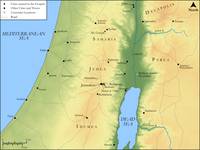 Judea in Jesus' Time