to answer I answer, reply, take up the conversation. ἀπο-κρίνω, [in LXX chiefly for ענה;] in cl., to separate, distinguish. to choose. Mid., to answer: Mt 27:12, Mk 14:61, Lk 3:16 23:9, Jo 5:17, 19, Ac 3:12. In late Gk. the pass, also is used in this sense, and pass. forms are the more freq. in NT (M, Pr., 39, 161; MM, s.v.); in general sense: absol., Mk 12:34; c. acc. rei, Mt 22:46; c. dat. pers., Mt 12:38; seq. πρός, Ac 25:16; Hebraistically like ענה, to begin to speak, take up the conversation (Kennedy, Sources, 124 f.): Mt 11:25, al., redundant, as in the Heb. phrase וַיַּעַן וַיּאֹמֶר (Dalman, Words, 24 f., 38; M, Pr., 14; Bl., § 58, 4; 74, 2; Cremer, 374): ἀποκριθεὶς εἶπε, Mt 4:4; ἔφη, 8:8; λέγει, Mk 3:33; in Jo most freq. ( ἀπεκ. κ. εἶπε, 1:49. Scroll for more
Jesus Jesus; the Greek form of Joshua; Jesus, son of Eliezer; Jesus, surnamed Justus. Ἰησοῦς, -οῦ, dat., voc. -οῦ, acc., -οῦν (Heb. יְהוֹשׁוּעַ, יְהֹשֻׁעַ, יֵשׁוּעַ ), JESUS: Mt 1:21, al.; ὁ Ἰ, Mt 3:13, al.; Ἰ. Χριστός, Mt 1:1, Mk 1:1, al.; Χρ. Ἰ., Ro 2:26, al.; κύριος Ἰ., Ac 28:31, al.; Ἰησοῦ, voc., Mk 1:24, al. Joshua: Ac 7:45, He 4:8. Jesus, son of Eliezer: Lk 3:29. Jesus, surnamed Justus: Col 4:11. v.s. βαραββᾶς. Scroll for more
the/this/who The, the definite article. ὁ, ἡ, τό, the prepositive article ( ἄρθρον προτακτικόν ), originally a demonstr. pron. (so usually in Hom.), in general corresponding to the Eng. definite article. As demonstr. pron. As freq. in Hom., absol., he ( she, it ), his (etc.): Ac 17:28 (quoted from the poet Aratus). Distributive, ὁ μὲν... ὁ δέ, the one... the other: I Co 7:7, Ga 4:22; pl., Ac 14:4, 17:32, Phl 1:16, al.; οἱ μὲν... ἄλλοι δέ, Mt 16:14, Jo 7:12; οἱ μεν̀... ὁ δέ, He 7:21, 23. In narration (without ὁ μὲν preceding), ὁ δέ, but he: Mt 2:14, Mk 1:45, Lk 8:21, Jo 9:38, al. mult. As prepositive article, the, prefixed, to nouns unmodified: ὁ θεός, τὸ φῶς, etc.; to abstract nouns, ἡ σοφία, etc., to pl. nouns which indicate a class, οἱ ἀλώπεκες, foxes, Mt 8:20, al.; to an individual as representing a class, ὁ ἐργάτης, Lk 10:7; c. nom. = voc. in addresses, Mt 11:26, Jo 19:3, Ja 5:1, al.; to things which pertain to one, ἡ χεῖρ, his hand, Mk 3:1; to names of persons well known or already mentioned; usually to names of countries (originally adjectives), ἡ Ἰουδαία, etc. To modified nouns: c. pers. pron. gen., μοῦ, σοῦ, etc.; c. poss. pron., ἐμός, σός, etc.; c. adj. between the art. and the noun, ὁ ἀγαθὸς ἄνθρωπος, Mt 12:35; the noun foll. by adj., both c. art., ὁ ποιμὴν ὁ καλός, Jo 10:11 (on ὁ ὄχλος πολύς, Jo 12:9, v. M, Pr., 84); before adjectival phrases, ἡ κατ’ ἐκλογὴν πρόθεσις, Ro 9:11. To Other parts of speech used as substantives; neuter adjectives: τ. ἀγαθόν, etc.; cardinal numerals: ὁ εἶς, οἷ δύο, etc.; participles: ὁ βαπτίζων (= ὁ Βαπτιστής, Mt 14:2 ), Mk 6:14; πᾶς ὁ, c. ptcp., every one who, etc.; adverbs: τὸ πέραν, τὰ νῦν, ὁ ἔσω ἄνθρωπος; infinitives: nom., τὸ θέλειν, Ro 7:18, al.; gen., τοῦ, after adjectives, ἄξιον τοῦ πορεύεσθαι, I Co 16:4; verbs, ἔλαχεν τοῦ θυμιᾶσαι, Lk 1:9; and freq. in a final sense, ἐξῆλθεν ὁ σπείρειν, Mt 13:3 (on the artic. inf., v. Bl., § 71). In the neut. to sentences, phrases or single words treated as a quotation: τὸ Ἐι δύνῃ, Mk 9:23; τὸ ἔτι ἅπαξ, He 12:27; τὸ ἀνέβη, Eph 4:9, al. To prepositional phrases: οἱ ἀπὸ Ἰταλίας, He 13:24; οἱ ἐκ νόμου, Ro 4:14; neut. acc. absol., in adverbial phrases, τὸ καθ’ ἡμέραν, daily, Lk 11:3; τὸ κατὰ σάρκα, as regards the flesh, Ro 9:5. To nouns in the genitive, denoting kinship, association, etc.: ὁ τοῦ, the son of (unless context indicates a different relationship), Mt 10:2, al.; τὰ τοῦ θεοῦ, the things that pertain to God, Mt 16:23; τὰ τῆς εἰρήνης, Ro 14:19 (cf. M, Pr., 81 ff.; Bl, §§ 46, 47). Scroll for more
kingdom Kingship, sovereignty, authority, rule, especially of God, both in the world, and in the hearts of men; hence: kingdom, in the concrete sense. βασιλεία, -ας, ἡ (< βασιλεύω ), [in LXX chiefly for מַמְלָכָה מַלְכוּת;] prop. abstract, sovereignty, royal power, dominion: Lk 1:33 22:29, Jo 18:36, Ac 1:6, He 1:8, I Co 15:24; λαβεῖν β., Lk 19:12, 15, Re 17:12; δοῦναι τὴν, Re 17:17; ἔχειν β., Re 17:18; ἔρχεσθαι ἐν τ. ( εἰς τὴν ) β., Mt 16:28, Lk 23:42; β. τ. θεοῦ, Re 12:10. By meton., concrete (MM, Exp., x), a kingdom, the territory or people over whom the king rules ( Es 5:3, al.): Mt 4:8 12:25, 26 24:7, Mk 3:24 6:23, Lk 4:5, He 11:33, al.; the royal majesty (cf. our phrase His Majesty ), the king himself ( τ. σπέρμα τῆς β., IV Ki 11:1 ). In LXX ( Wi 6:5, To 13:1, al.), Targ. and NT, of the Messianic rule and kingdom, ἡ β. τ. θεοῦ, τ. οὐρανῶν (Heb. מַלְכוּת שָׁמַיִם, Aram. מַלְכוּתָא דִשׁמַיָּא; v. Dalman, Words, 91-147; Cremer, 132, 658), the kingdom of God (on the equivalence of the two phrases, v. Dalman, op. cit., 93, 218 f.); τ. θεοῦ, Mt 6:33 12:28, al.; τ. οὐρανῶν, Mt 3:2 4:17, al.; τ. Χριστοῦ ( מַלִכוּת דִמְשִׁיחא, Targ. Jon. on Is 53:10 ), Eph 5:5; τ. κυρίου, II Pe 1:11, Re 11:15; τ. Δαυείδ, Mk 11:10; absol., ἡ β., Mt 4:23, Ja 2:5, al. The kingdom is regarded as present: Mt 11:12, Lk 17:21, Ro 14:17, al.; as that which is to be consummated in the future, Mt 6:10, Mk 9:1, Jo 3:5, II Pe 1:11, al. Noteworthy phrases are: ζητεῖν τὴν β., Mt 6:33; δέχεσθαι, Mk 10:15; κλρονομεῖν, Mt 25:34; διδόναι, Lk 12:32; παραλαμβάνειν, He 12:28; αὐτῶν ( τοιούτων ) ἐστὶν ἡ β., Mt 5:3, 10 19:14, Mk 10:14, Lk 18:16; διὰ τὴν β., Mt 19:12; ἕνεκεν τῆς β., Lk 18:29; εὐαγγελίζεσθαι, κηρύσσειν, διαγγέλλειν τὴν β., Lk 4:43 9:2, 60; ἤγγικεν ἡ β., Mt 3:2, Mk 1:15; κλεῖς τῆς β., Mt 16:19; κλείειν τὴν β., Mt 23:14; υἱοὶ τῆς β., Mt 8:12 13:38 (cf. Cremer, 132, 658). Scroll for more
the/this/who The, the definite article. ὁ, ἡ, τό, the prepositive article ( ἄρθρον προτακτικόν ), originally a demonstr. pron. (so usually in Hom.), in general corresponding to the Eng. definite article. As demonstr. pron. As freq. in Hom., absol., he ( she, it ), his (etc.): Ac 17:28 (quoted from the poet Aratus). Distributive, ὁ μὲν... ὁ δέ, the one... the other: I Co 7:7, Ga 4:22; pl., Ac 14:4, 17:32, Phl 1:16, al.; οἱ μὲν... ἄλλοι δέ, Mt 16:14, Jo 7:12; οἱ μεν̀... ὁ δέ, He 7:21, 23. In narration (without ὁ μὲν preceding), ὁ δέ, but he: Mt 2:14, Mk 1:45, Lk 8:21, Jo 9:38, al. mult. As prepositive article, the, prefixed, to nouns unmodified: ὁ θεός, τὸ φῶς, etc.; to abstract nouns, ἡ σοφία, etc., to pl. nouns which indicate a class, οἱ ἀλώπεκες, foxes, Mt 8:20, al.; to an individual as representing a class, ὁ ἐργάτης, Lk 10:7; c. nom. = voc. in addresses, Mt 11:26, Jo 19:3, Ja 5:1, al.; to things which pertain to one, ἡ χεῖρ, his hand, Mk 3:1; to names of persons well known or already mentioned; usually to names of countries (originally adjectives), ἡ Ἰουδαία, etc. To modified nouns: c. pers. pron. gen., μοῦ, σοῦ, etc.; c. poss. pron., ἐμός, σός, etc.; c. adj. between the art. and the noun, ὁ ἀγαθὸς ἄνθρωπος, Mt 12:35; the noun foll. by adj., both c. art., ὁ ποιμὴν ὁ καλός, Jo 10:11 (on ὁ ὄχλος πολύς, Jo 12:9, v. M, Pr., 84); before adjectival phrases, ἡ κατ’ ἐκλογὴν πρόθεσις, Ro 9:11. To Other parts of speech used as substantives; neuter adjectives: τ. ἀγαθόν, etc.; cardinal numerals: ὁ εἶς, οἷ δύο, etc.; participles: ὁ βαπτίζων (= ὁ Βαπτιστής, Mt 14:2 ), Mk 6:14; πᾶς ὁ, c. ptcp., every one who, etc.; adverbs: τὸ πέραν, τὰ νῦν, ὁ ἔσω ἄνθρωπος; infinitives: nom., τὸ θέλειν, Ro 7:18, al.; gen., τοῦ, after adjectives, ἄξιον τοῦ πορεύεσθαι, I Co 16:4; verbs, ἔλαχεν τοῦ θυμιᾶσαι, Lk 1:9; and freq. in a final sense, ἐξῆλθεν ὁ σπείρειν, Mt 13:3 (on the artic. inf., v. Bl., § 71). In the neut. to sentences, phrases or single words treated as a quotation: τὸ Ἐι δύνῃ, Mk 9:23; τὸ ἔτι ἅπαξ, He 12:27; τὸ ἀνέβη, Eph 4:9, al. To prepositional phrases: οἱ ἀπὸ Ἰταλίας, He 13:24; οἱ ἐκ νόμου, Ro 4:14; neut. acc. absol., in adverbial phrases, τὸ καθ’ ἡμέραν, daily, Lk 11:3; τὸ κατὰ σάρκα, as regards the flesh, Ro 9:5. To nouns in the genitive, denoting kinship, association, etc.: ὁ τοῦ, the son of (unless context indicates a different relationship), Mt 10:2, al.; τὰ τοῦ θεοῦ, the things that pertain to God, Mt 16:23; τὰ τῆς εἰρήνης, Ro 14:19 (cf. M, Pr., 81 ff.; Bl, §§ 46, 47). Scroll for more
mine My, mine. ἐμός, -ή, -όν poss. prop. of first pers., representing the emphasized gen. ἐμοῦ, mine, subjectively and objectively, i.e. belonging to, proceeding from or related to me: Mt 18:20, Mk 8:38, Jo 3:29 (most freq. in this gospel), al.; absol., τὸ ἐμόν, τὰ ἐμά, Mt 20:15 25:27, Lk 15:31, Jo 10:14 16:14, 15 17:10; = gen. obj. (cl.), εἰς τ. ἐμὴν ἀνάμνησιν, Lk 22:19, I Co 11:24, 25; c. gen. expl., τ. ἐμῇ χειρὶ Παύλου, I Co 16:21, Col 4:18, II Th 3:17 Scroll for more
no No, not. οὐ, before a vowel with smooth breathing οὐκ, before one with rough breathing οὐχ (but improperly οὐχ ἰδού, Ac 2:7, WH, mg.; cf. WH, Intr., § 409; M, Pr., 44, 244), [in LXX for לֹא, אַיִן, אֵין;] neg. particle, not, no, used generally c. indic. and for a denial of fact (cf. μή ); absol. (accented), οὔ, no: Mt 13:29, Jo 1:21 21:5; οὒ οὔ, Mt 5:37, Ja 5:12. Most freq. negativing a verb or other word, Mt 1:25 10:26, 38, Mk 3:25 9:37, Jo 8:29, Ac 7:5, Ro 1:16, Phl 3:3, al.; in litotes, οὐκ ὀλίγοι (i.e. very many ), Ac 17:4, al.; οὐκ ἄσημος, Ac 21:39; πᾶς... οὐ, c. verb, (like Heb. כֹּל... לֹא ), no, none, Mt 24:22, Mk 13:20, Lk 1:37, Eph 5:5, al.; in disjunctive statements, οὐκ... ἀλλά, Lk 8:52, Jo 1:33, Ro 8:20, al.; c. 2 pers. fut. (like Heb. לֹא, c. impf.), as emphatic prohibition, Mt 4:7, Lk 4:12, Ro 7:7, al. With another negative, strengthening the negation: Mk 5:37, Jo 8:15 12:19, Ac 8:39, al.; making an affirmative: Ac 4:20, I Co 12:15. With other particles: οὐ μή (v.s. μή ); οὐ μηκέτι, Mt 21:19; with μή interrog., Ro 10:18, I Co 9:4, 5 11:22. Interrogative, expecting an affirmative answer (Lat. nonne ): Mt 6:26, Mk 4:21, Lk 11:40, Jo 4:35, Ro 9:21, al. Scroll for more
he is εἰμί, with various uses and significations, like the English verb to be. As substantive verb. Of persons and things, to be, exist: Ac 17:28, Jo 1:1 8:58 17:5, al; ὁ ὢν καὶ ὁ ἦν (for past ptcp.), Re 1:4, 8 4:8 11:17 16:5 (v. Swete, Ap., 5; M, Pr., 228); τὰ (μὴ) ὄντα, Ro 4:17, I Co 1:28. Of times, events, etc., to be, happen, take place: Mt 24:3, Mk 14:2 15:42, Lk 21:23, Jo 4:6, 23 5:10, al. to be present, be in a place, have come: Mt 2:13, 15, Mk 1:45 5:21 15:40, Lk 1:80 5:29, Jo 7:30, al.; seq. εἰς, Mk 2:1; seq. ἐκ, (ἐξ), Mt 1:20 21:25, Mk 11:30, Jo 3:31, al. Impers., ἔστι, ἦν, etc.; there is (Fr. il y a ), was, etc.: Mt 16:28, Lk 16:19, Jo 3:1 5:2, Ro 3:10, al.; c. dat. (of the possessor; Bl., §37, 3), Mt 16:22, Lk 1:7, Jo 18.10, Ro 9:2, al.; ἔστιν ὅς, ὅστις (chiefly in pl), Mt 16:28 19:2, Mk 9:1, al.; c. inf., = ἔξεστιν (q.v.), it is possible: He 9:5, I Co 11:20, RV (but v. ICC, in l.). As copula uniting subject and predicate. Expressing simply identity or equivalence: Mt 5:13 14:15, Lk 1:18, 19, Jo 1:1 4:19, Re 3:9, al. mult. Explicative, as in parable, figure, type, etc.: Mt 13:19, I Co 9:2, 10:4, 11:25, Ga 4:24, Re 17:15, al.; τοῦτ’ ἔστιν, Mt 27:46, Mk 7:2, Ro 7:18 al.; ὅ ἐστιν, Mk 3:17, Col 1:24, He 7:2, al.; akin to this is the sacramental usage: Mt 26:26-28, Mk 14:22, 24, Lk 22:19, I Co 11:24 (v. ICC on Mk, I Co, ll. c.; DB, iii, 148 f.). C. gen.: qual., etc., Mk 5:42, Lk 3:23, I Co 14:33, He 12:11, al.; part., I Ti 1:20, II Ti 1:15; poss., Mt 5:3, 10, Mk 12:7, Lk 4:7; of service or partisanship, Ro 8:9, I Co 1:12, II Co 10:7, II Ti 2:19. C. dat. (BL, §37, 3): Ac 1:8 9:15, Ro 4:12, I Co 1:18 2:14, Re 21:7, al. C. ptcp., as a periphrasis for the simple verb (Bl., §62, 1, 2; M, Pr., 225 ff.); c. ptcp. pf. (cl.): Mt 10:30, Lk 9:32, Jo 3:24, Ac 21:35, I Co 15:19, al; c. ptcp. pr. (esp. in impf., as in Heb. and Aram.; Dalman, Words, 35 f.), Mt 7:29, Mk 1:22, Lk 4:31 14:1, Ac 1:10, al. mult., id. for imper. (M, Pr., 180f., 182f.), with ellipsis of εἰμί, Ro 12:9, 10, He 13:5, al.; c. ptcp. aor. (cl), Lk 23:9. Seq. εἰς (cf. Heb. הָיָה לְ ), a vernac. usage (M, Pr., 71): Mt 19:5, Mk 10:8, He 8:10, al. C. adv.: Mt 19:20, Mk 4:26, Lk 18:11, al. Ellipses; of the copula (Bl., §30, 3): Mt 8:29 24:32, Jo 21:22, 23, He 6:4, al.; of the predicate: ἐγώ εἰμί, Mt 14:27, Mk 6:50, al.; absol. (cf. De 32:39; אֲנִי הוּא ), Mk 13:6, Jo 4:26, al. (cf. ἄπ-, ἔν-, πάρ-, συμ-πάρ-, σύν-ειμι ). Scroll for more
out from From out, out from among, from, suggesting from the interior outwards. ἐκ ( ἐξ ), prep. c. gen., from out of, from ( see Addendum, p. 492). This entry is included here, but in the print version the entry is found on p. 492. ἐκ, before a vowel ἐξ, prep. c. gen., of motion outwards, separation from (opp. to εἰς; = Lat. e, ex ), from out of, from among, from. Of Place, of motion, out of, forth from, off from: Jo 6:31, Ac 9:3, Ga 1:8, al.; esp. after verbs of motion, Mt 8:28 17:9, Mk 1:25 7:28, Jo 1:33 20:1, Ac 12:7, 17 27:30, al.; constr. praeg., σώζειν (διας.) ἐκ, Ju 5, Ac 28:4. Metaph., Mt 7:4, 5, I Pe 2:9; ἐκ τ. χειρός (-ῶν), seq. gen. pers., Lk 1:74, Jo 10:28, 29, 39, Ac 12:4 24:7, Re 19:2; πίνειν (q.v.) ἐκ; of the place from which an action proceeds, Lk 5:3 (cf. 12:36, Jo 13:4, II Co 2:4 ). Of change from one place or condition to another: Jo 8:42, Ro 6:13 13:11, Re 7:14, al.; c. ellips. of verb of motion, II Ti 2:26, II Pe 2:21, Re 2:21, al. Of separation or distinction from a number, before collective or pl. nouns: Mt 13:47, 49, Jo 12:1, Ac 3:15, I Pe 1:3, al.; after εἷς, Mt 10:29, Lk 17:15, al.; οὐδείς, Jo 7:19, al.; πολλοί, Jo 11:19, al.; τις, Lk 11:15, al.; τίς, Mt 6:27, al.; in partitive phrase as subject of sentence, Jo 16:17; Hebraistically, ἐκ μέσου seq. gen., = ἐκ (Heb. מִתֹּוךְ ), Mt 13:49, al. Of position or direction (so in cl. = ἔξω ): ἐκ δεξιῶν (v.s. δεξιός ); ἐξ ἐναντίας, Mk 15:39 (metaph., Tit 2:8 ); ἐκ ῥιζῶν (i.e., utterly ), Mt 11:20. Of Time, of the point of time from which, from, since: ἐκ γενετῆς, Jo 9:1, cf. Mk 10:20, Lk 23:8, Ac 24:10, al. Of succession in time: ἐκ δευτέρου, a second time, Mk 14:72, al., cf. Mt 26:44; ἡμέραν ἐξ ἡμέρας, from day to day, II Pe 2:8. Of Origin, of nativity, lineage, race: κοίτην (ἐν γαστρί) ἔχειν, Ro 9:10, Mt 1:18; γεννᾶν ἐκ, Mt 1:3 ff.; γεννᾶσθαι (γίνεσθαι) ἐκ, Jo 3:6 8:41, Ga 4:4; ἐκ πνεύματος (θεοῦ), Jo 1:13 3:5 ff., al. ἔρχεσθαι, εἶναι, etc., ἐκ τ. πολέως, Jo 1:44; φυλῆς, Lk 2:36, al.; τ. ἐξουσίας Ἡρῴδου, Lk 23:7; ὁ ὢν ἐκ τ. γῆς, Jo 3:31. Of the author, occasion or source: Mt 5:37, Jo 2:16, Ro 2:29, I Co 8:6, Ga 5:8, al.; ἐκ (τ.) θεοῦ, I Co 7:7, II Co 5:1, I Jo 4:7; ἐκ τ. πατρός, Jo 6:65, al.; ἐκ τ. γῆς ἐστιν, λαλεῖ, Jo 3:31; εκ καρδίας, Ro 6:17, cf. Mk 12:30, I Ti 1:5; ἐκ ψυχῆς, Eph 6:6, Col 3:23; ἐκ πίστεως, Ro 14:23; κρίνειν ἐκ, Lk 19:22, Re 20:12. Of the agent, after passive verbs: Mt 15:5, Mk 7:11, II Co 2:2, al.; freq. in Re after αδικεῖσθαι ( 2:11 ), etc. Of cause, dependence, source of supply: τ. πόνου (των), Re 16:10, 11; τ. φωνῶν, Re 8:13; ἐκ τούτου, Jo 6:66 19:12 (but v. Meyer, in ll.); ἐκ θεοῦ λαλεῖν, II Co 2:17; ἐκ τ. ἀληθείας εἶναι, Jo 18:37, I Jo 3:19; ὁ ἐκ πίστεως, Ro 3:26 4:16; οἱ (ὄντες) ἐκ περιτομῆς, Ac 11:2, Ro 4:12, Ga 2:12, Col 4:11; πίνειν ἐκ, Mt 26:29, Mk 14:25, Jo 4:13, al.; θερίζειν, Ga 6:8; μετέχειν ἐκ (= partit. gen.), I Co 10:13; c. inf., ἐκ τοῦ ἔχειν, II Co 8:11. Of material: Mt 27:29, Jo 2:15 19:2, Ro 9:21, I Co 11:12, Re 18:12, al.; allied to which is its use of price (= cl. gen.): Mt 27:7, cf. ib. 20:2, Ac 1:18. By attraction = ἐν (cl.): τὰ ἐκ τ. οἰκιας, Mt 24:17; τ. ἐξ αὐτοῦ δύναμιν, Mk 5:30 (v. Field, in l.); ὁ πατὴρ ὁ ἐξ οὐρανοῦ, Lk 11:13. Adverbial phrases: ἐξ ἀνάγκης, II Co 9:7, He 7:12; ἐξ ἰσότητος, II Co 8:13; ἐκ μέρους, I Co 12:27 13:9-12; ἐκ μέτρου, Jo 3:34; ἐκ συμφώνου, I Co 7:5. in composition, ἐκ signifies, procession, removal: ἐκβαίνω, ἐκβάλλω. Opening out, unfolding: ἐκτείνω; metaph., ἐξαγγάλλω. Origin: ἔκγονος. Completeness: ἐξαπορέω (v. M, Pr., 237), ἐκπληρόω, ἐκτελέω. Scroll for more
the/this/who The, the definite article. ὁ, ἡ, τό, the prepositive article ( ἄρθρον προτακτικόν ), originally a demonstr. pron. (so usually in Hom.), in general corresponding to the Eng. definite article. As demonstr. pron. As freq. in Hom., absol., he ( she, it ), his (etc.): Ac 17:28 (quoted from the poet Aratus). Distributive, ὁ μὲν... ὁ δέ, the one... the other: I Co 7:7, Ga 4:22; pl., Ac 14:4, 17:32, Phl 1:16, al.; οἱ μὲν... ἄλλοι δέ, Mt 16:14, Jo 7:12; οἱ μεν̀... ὁ δέ, He 7:21, 23. In narration (without ὁ μὲν preceding), ὁ δέ, but he: Mt 2:14, Mk 1:45, Lk 8:21, Jo 9:38, al. mult. As prepositive article, the, prefixed, to nouns unmodified: ὁ θεός, τὸ φῶς, etc.; to abstract nouns, ἡ σοφία, etc., to pl. nouns which indicate a class, οἱ ἀλώπεκες, foxes, Mt 8:20, al.; to an individual as representing a class, ὁ ἐργάτης, Lk 10:7; c. nom. = voc. in addresses, Mt 11:26, Jo 19:3, Ja 5:1, al.; to things which pertain to one, ἡ χεῖρ, his hand, Mk 3:1; to names of persons well known or already mentioned; usually to names of countries (originally adjectives), ἡ Ἰουδαία, etc. To modified nouns: c. pers. pron. gen., μοῦ, σοῦ, etc.; c. poss. pron., ἐμός, σός, etc.; c. adj. between the art. and the noun, ὁ ἀγαθὸς ἄνθρωπος, Mt 12:35; the noun foll. by adj., both c. art., ὁ ποιμὴν ὁ καλός, Jo 10:11 (on ὁ ὄχλος πολύς, Jo 12:9, v. M, Pr., 84); before adjectival phrases, ἡ κατ’ ἐκλογὴν πρόθεσις, Ro 9:11. To Other parts of speech used as substantives; neuter adjectives: τ. ἀγαθόν, etc.; cardinal numerals: ὁ εἶς, οἷ δύο, etc.; participles: ὁ βαπτίζων (= ὁ Βαπτιστής, Mt 14:2 ), Mk 6:14; πᾶς ὁ, c. ptcp., every one who, etc.; adverbs: τὸ πέραν, τὰ νῦν, ὁ ἔσω ἄνθρωπος; infinitives: nom., τὸ θέλειν, Ro 7:18, al.; gen., τοῦ, after adjectives, ἄξιον τοῦ πορεύεσθαι, I Co 16:4; verbs, ἔλαχεν τοῦ θυμιᾶσαι, Lk 1:9; and freq. in a final sense, ἐξῆλθεν ὁ σπείρειν, Mt 13:3 (on the artic. inf., v. Bl., § 71). In the neut. to sentences, phrases or single words treated as a quotation: τὸ Ἐι δύνῃ, Mk 9:23; τὸ ἔτι ἅπαξ, He 12:27; τὸ ἀνέβη, Eph 4:9, al. To prepositional phrases: οἱ ἀπὸ Ἰταλίας, He 13:24; οἱ ἐκ νόμου, Ro 4:14; neut. acc. absol., in adverbial phrases, τὸ καθ’ ἡμέραν, daily, Lk 11:3; τὸ κατὰ σάρκα, as regards the flesh, Ro 9:5. To nouns in the genitive, denoting kinship, association, etc.: ὁ τοῦ, the son of (unless context indicates a different relationship), Mt 10:2, al.; τὰ τοῦ θεοῦ, the things that pertain to God, Mt 16:23; τὰ τῆς εἰρήνης, Ro 14:19 (cf. M, Pr., 81 ff.; Bl, §§ 46, 47). Scroll for more
world The world, universe; worldly affairs; the inhabitants of the world; adornment. κόσμος, -ου, ὁ [in LXX: Ge 2:1, De 4:19 17:3, Is 24:21 40:26 ( צבא ), Ex 33:5, 6, Je 2:32 4:30, Ez 7:20 16:11 23:40 ( עֲדִי ), Is 61:10 ( כְּלִי ), al., Wi 2:24 and freq., Si 6:30, al;] order (Hom., Plat., al.). ornament, adornment, esp. of women (Hom., al.): I Pe 3:3. Later, the world or universe, as an ordered system (Plat., al.): Ac 17:24, Ro 4:13, I Co 3:22, Phl 2:15, He 4:3, al. In late writers only, the world, i.e. the earth (= ἡ οἰκουμένη, cf. Mt 4:8 with Lk 4:5 ): Mt 4:8, Mk 16:[15], Col 2:20, I Ti 6:7, al.; hence by meton., of the human inhabitants of the world: Mt 5:14 13:38, Mk 14:9, Jo 1:10 4:42 12:47, Ro 3:6, I Co 4:13, II Co 5:19, II Pe 2:5, al.; of worldly affairs or possessions: Mt 16:26, Mk 8:36, Lk 9:25, I Co 7:31, I Jo 2:16, al.; in ethical sense, of the ungodly: Jo 7:7 14:17, 27, I Co 1:21, Ja 1:27, I Jo 4:4, al.; metaph.: ὁ κ. τῆς ἀδικίας, Ja 3:6. SYN.: αἰών, q.v. (cf. also Dalman, Words, 162 ff.; Tr., Syn., § lix; Westc., additional note on Jo 1:10; DB, iv, 938 ff.). Scroll for more
of this οὗτος, αὕτη, τοῦτο, gen., τούτου, ταύτης, τούτου, [in LXX chiefly for זֶה, זֹאת;] demonstr. pron. (related to ἐκεῖνος as hic to ille ), this; as subst., this one, he; absol.: Mt 3:17, Mk 9:7, Lk 7:44, 45, Jo 1:15, Ac 2:15, al.; expressing contempt (cl.), Mt 13:55, 56, Mk 6:2, 3, Jo 6:42, al.; εἰς τοῦτο, Mk 1:38, Ro 14:9; μετὰ τοῦτο ( ταῦτα; V. Westc. on Jo 5:1 ), Jo 2:12 11:7, al.; epanaleptic (referring to what precedes): Mt 5:19, Mk 3:35, Lk 9:48, Jo 6:46, Ro 7:10, al.; proleptic (referring to what follows): seq. ἵνα (Bl., § 69, 6), Lk 1:43, Jo 3:19 (and freq.) 15:8, Ro 14:9, al.; seq. ὅτι, Lk 10:11, Jo 9:30, Ac 24:14, Ro 2:3, al.; ὅπως, Ro 9:17; ἐάν, Jo 13:35; special idioms: τοῦτο μὲν... τ. δέ (cl), partly... partly, He 10:33; καὶ τοῦτο ( τοῦτον, ταῦτα ), and that ( him ) too, Ro 13:11, I Co 2:2, He 11:12; τοῦτ’ ἐστιν, that is to say, Mt 27:46. As adj., c. subst.; c. art. before the art.: Mt 12:32, Mk 9:29, Lk 7:44, Jo 4:15, Ro 11:24, Re 19:9, al.; after the noun: Mt 3:9, Mk 12:16, Lk 11:31, Jo 4:13, Ac 6:13, Ro 15:28, I Co 1:20, Re 2:24, al.; c. subst. anarth. (with predicative force; Bl., § 49, 4): Lk 1:36 2:2 24:21, Jo 2:11 4:54 21:14, II Co 13:1. Scroll for more
if If. εἰ, conjunctive particle, used in conditions and in indirect questions. Conditional, if; c. indic., expressing a general assumption; pres.: seq. indic, pres., Mt 11:14, Ro 8:25, al.; seq. imperat., Mk 4:23 9:22, Jo 15:18, I Co 7:9, al.; seq. fut. indic., Lk 16:31, Ro 8:11, al.; seq. pf. or aor., with negation in apodosis, Mt 12:26, Ro 4:14, al.; similarly, seq. impf., Lk 17:6, Jo 8:39; seq. quæst., Mt 6:23, Jo 5:47 7:23 8:46, I Pe 2:20; fut.: Mt 26:33, I Pe 2:20; pf.: Jo 11:12, Ro 6:5, al.; aor.: Lk 16:11 19:8, Jo 13:32, 18:23, Re 20:15, al. Where the assumption is certain = ἐπεί: Mt 12:28, Jo 7:4, Ro 5:17, al. Of an unfulfilled condition, c. indic, impf., aor. or plpf., seq. ἄν, c. imp. or aor. (v.s. ἄν, I, i). C. indic., after verbs denoting wonder, etc., sometimes, but not always, coupled with an element of doubt: Mk 15:44, I Jo 3:13, al. C. indic., as in LXX ( Nu 14:3o, I Ki 14:45, al. = Heb. אִם ), in oaths, with the formula of imprecation understood in a suppressed apodosis (WM, 627; Burton, §272): Mk 8:12, He 3:11 (LXX) 4:3 (LXX). Rarely (cl.) c. optat., to express a merely possible condition: Ac 24:19 27:39, I Co 14:10 15:37, I Pe3:14, 17. Interrogative, if, whether. As in cl., in indir. questions after verbs of seeing, asking, knowing, saying, etc.: c. indic. pres., Mt 26:63, Mk 15:36, Ac 19:2, II Co 13:5, al.; fut., Mk 3:2, Ac 8:22, al.; aor., Mk 15:44, I Co 1:16, al.; c. subjc. aor. (M, Pr., 194), Phl 3:12. As in LXX (= Heb. אִם and interrog. הֲ, Ge 17:17, al.; v. WM, 639 f.; Viteau, i, 22), in direct questions: Mk 8:23 (Tr., WH, txt.), Lk 13:23, 22:49, Ac 19:2, al. With other particles. εἰ ἄρα, εἴγε, εἰ δὲ μήγε, v.s. ἄρα, γε. εἰ δὲ καί, but if also: Lk 11:18; but even if, I Co 4:7, II Co 4:3 11:16. εἰ δὲ μή, but if not, but if otherwise: Mk 2:21, 22, Jo 14:2, Re 2:5, al. εἰ καί, if even, if also, although: Mk 14:29, Lk 11:8, I Co 7:21, II Co 4:16, Phl 2:17, al. καὶ εἰ, even if, v.s. καί εἰ μή, if not, unless, except, but only: Mt 24:22, Mk 2:26 6:5, Jo 9:33, I Co 7:17 ( only ), Ga 1:19 (cf. ἐὰν μή, 2:16; v. Hort., Ja., xvi); ἐκτὸς εἰ μή, pleonastic (Bl., §65, 6), I Co 14:5 15:2, I Ti 5:19. εἰ μήν = cl. ἦ μήν (M, Pr., 46), in oaths, surely ( Ez 33:27, al.): He 6:14. εἴ πως, if haply: Ac 27:12, Ro 1:10. εἴτε... εἴτε, whether... or: Ro 12:6-8, I Co 3:22 13:8, al. Scroll for more
out from From out, out from among, from, suggesting from the interior outwards. ἐκ ( ἐξ ), prep. c. gen., from out of, from ( see Addendum, p. 492). This entry is included here, but in the print version the entry is found on p. 492. ἐκ, before a vowel ἐξ, prep. c. gen., of motion outwards, separation from (opp. to εἰς; = Lat. e, ex ), from out of, from among, from. Of Place, of motion, out of, forth from, off from: Jo 6:31, Ac 9:3, Ga 1:8, al.; esp. after verbs of motion, Mt 8:28 17:9, Mk 1:25 7:28, Jo 1:33 20:1, Ac 12:7, 17 27:30, al.; constr. praeg., σώζειν (διας.) ἐκ, Ju 5, Ac 28:4. Metaph., Mt 7:4, 5, I Pe 2:9; ἐκ τ. χειρός (-ῶν), seq. gen. pers., Lk 1:74, Jo 10:28, 29, 39, Ac 12:4 24:7, Re 19:2; πίνειν (q.v.) ἐκ; of the place from which an action proceeds, Lk 5:3 (cf. 12:36, Jo 13:4, II Co 2:4 ). Of change from one place or condition to another: Jo 8:42, Ro 6:13 13:11, Re 7:14, al.; c. ellips. of verb of motion, II Ti 2:26, II Pe 2:21, Re 2:21, al. Of separation or distinction from a number, before collective or pl. nouns: Mt 13:47, 49, Jo 12:1, Ac 3:15, I Pe 1:3, al.; after εἷς, Mt 10:29, Lk 17:15, al.; οὐδείς, Jo 7:19, al.; πολλοί, Jo 11:19, al.; τις, Lk 11:15, al.; τίς, Mt 6:27, al.; in partitive phrase as subject of sentence, Jo 16:17; Hebraistically, ἐκ μέσου seq. gen., = ἐκ (Heb. מִתֹּוךְ ), Mt 13:49, al. Of position or direction (so in cl. = ἔξω ): ἐκ δεξιῶν (v.s. δεξιός ); ἐξ ἐναντίας, Mk 15:39 (metaph., Tit 2:8 ); ἐκ ῥιζῶν (i.e., utterly ), Mt 11:20. Of Time, of the point of time from which, from, since: ἐκ γενετῆς, Jo 9:1, cf. Mk 10:20, Lk 23:8, Ac 24:10, al. Of succession in time: ἐκ δευτέρου, a second time, Mk 14:72, al., cf. Mt 26:44; ἡμέραν ἐξ ἡμέρας, from day to day, II Pe 2:8. Of Origin, of nativity, lineage, race: κοίτην (ἐν γαστρί) ἔχειν, Ro 9:10, Mt 1:18; γεννᾶν ἐκ, Mt 1:3 ff.; γεννᾶσθαι (γίνεσθαι) ἐκ, Jo 3:6 8:41, Ga 4:4; ἐκ πνεύματος (θεοῦ), Jo 1:13 3:5 ff., al. ἔρχεσθαι, εἶναι, etc., ἐκ τ. πολέως, Jo 1:44; φυλῆς, Lk 2:36, al.; τ. ἐξουσίας Ἡρῴδου, Lk 23:7; ὁ ὢν ἐκ τ. γῆς, Jo 3:31. Of the author, occasion or source: Mt 5:37, Jo 2:16, Ro 2:29, I Co 8:6, Ga 5:8, al.; ἐκ (τ.) θεοῦ, I Co 7:7, II Co 5:1, I Jo 4:7; ἐκ τ. πατρός, Jo 6:65, al.; ἐκ τ. γῆς ἐστιν, λαλεῖ, Jo 3:31; εκ καρδίας, Ro 6:17, cf. Mk 12:30, I Ti 1:5; ἐκ ψυχῆς, Eph 6:6, Col 3:23; ἐκ πίστεως, Ro 14:23; κρίνειν ἐκ, Lk 19:22, Re 20:12. Of the agent, after passive verbs: Mt 15:5, Mk 7:11, II Co 2:2, al.; freq. in Re after αδικεῖσθαι ( 2:11 ), etc. Of cause, dependence, source of supply: τ. πόνου (των), Re 16:10, 11; τ. φωνῶν, Re 8:13; ἐκ τούτου, Jo 6:66 19:12 (but v. Meyer, in ll.); ἐκ θεοῦ λαλεῖν, II Co 2:17; ἐκ τ. ἀληθείας εἶναι, Jo 18:37, I Jo 3:19; ὁ ἐκ πίστεως, Ro 3:26 4:16; οἱ (ὄντες) ἐκ περιτομῆς, Ac 11:2, Ro 4:12, Ga 2:12, Col 4:11; πίνειν ἐκ, Mt 26:29, Mk 14:25, Jo 4:13, al.; θερίζειν, Ga 6:8; μετέχειν ἐκ (= partit. gen.), I Co 10:13; c. inf., ἐκ τοῦ ἔχειν, II Co 8:11. Of material: Mt 27:29, Jo 2:15 19:2, Ro 9:21, I Co 11:12, Re 18:12, al.; allied to which is its use of price (= cl. gen.): Mt 27:7, cf. ib. 20:2, Ac 1:18. By attraction = ἐν (cl.): τὰ ἐκ τ. οἰκιας, Mt 24:17; τ. ἐξ αὐτοῦ δύναμιν, Mk 5:30 (v. Field, in l.); ὁ πατὴρ ὁ ἐξ οὐρανοῦ, Lk 11:13. Adverbial phrases: ἐξ ἀνάγκης, II Co 9:7, He 7:12; ἐξ ἰσότητος, II Co 8:13; ἐκ μέρους, I Co 12:27 13:9-12; ἐκ μέτρου, Jo 3:34; ἐκ συμφώνου, I Co 7:5. in composition, ἐκ signifies, procession, removal: ἐκβαίνω, ἐκβάλλω. Opening out, unfolding: ἐκτείνω; metaph., ἐξαγγάλλω. Origin: ἔκγονος. Completeness: ἐξαπορέω (v. M, Pr., 237), ἐκπληρόω, ἐκτελέω. Scroll for more
the/this/who The, the definite article. ὁ, ἡ, τό, the prepositive article ( ἄρθρον προτακτικόν ), originally a demonstr. pron. (so usually in Hom.), in general corresponding to the Eng. definite article. As demonstr. pron. As freq. in Hom., absol., he ( she, it ), his (etc.): Ac 17:28 (quoted from the poet Aratus). Distributive, ὁ μὲν... ὁ δέ, the one... the other: I Co 7:7, Ga 4:22; pl., Ac 14:4, 17:32, Phl 1:16, al.; οἱ μὲν... ἄλλοι δέ, Mt 16:14, Jo 7:12; οἱ μεν̀... ὁ δέ, He 7:21, 23. In narration (without ὁ μὲν preceding), ὁ δέ, but he: Mt 2:14, Mk 1:45, Lk 8:21, Jo 9:38, al. mult. As prepositive article, the, prefixed, to nouns unmodified: ὁ θεός, τὸ φῶς, etc.; to abstract nouns, ἡ σοφία, etc., to pl. nouns which indicate a class, οἱ ἀλώπεκες, foxes, Mt 8:20, al.; to an individual as representing a class, ὁ ἐργάτης, Lk 10:7; c. nom. = voc. in addresses, Mt 11:26, Jo 19:3, Ja 5:1, al.; to things which pertain to one, ἡ χεῖρ, his hand, Mk 3:1; to names of persons well known or already mentioned; usually to names of countries (originally adjectives), ἡ Ἰουδαία, etc. To modified nouns: c. pers. pron. gen., μοῦ, σοῦ, etc.; c. poss. pron., ἐμός, σός, etc.; c. adj. between the art. and the noun, ὁ ἀγαθὸς ἄνθρωπος, Mt 12:35; the noun foll. by adj., both c. art., ὁ ποιμὴν ὁ καλός, Jo 10:11 (on ὁ ὄχλος πολύς, Jo 12:9, v. M, Pr., 84); before adjectival phrases, ἡ κατ’ ἐκλογὴν πρόθεσις, Ro 9:11. To Other parts of speech used as substantives; neuter adjectives: τ. ἀγαθόν, etc.; cardinal numerals: ὁ εἶς, οἷ δύο, etc.; participles: ὁ βαπτίζων (= ὁ Βαπτιστής, Mt 14:2 ), Mk 6:14; πᾶς ὁ, c. ptcp., every one who, etc.; adverbs: τὸ πέραν, τὰ νῦν, ὁ ἔσω ἄνθρωπος; infinitives: nom., τὸ θέλειν, Ro 7:18, al.; gen., τοῦ, after adjectives, ἄξιον τοῦ πορεύεσθαι, I Co 16:4; verbs, ἔλαχεν τοῦ θυμιᾶσαι, Lk 1:9; and freq. in a final sense, ἐξῆλθεν ὁ σπείρειν, Mt 13:3 (on the artic. inf., v. Bl., § 71). In the neut. to sentences, phrases or single words treated as a quotation: τὸ Ἐι δύνῃ, Mk 9:23; τὸ ἔτι ἅπαξ, He 12:27; τὸ ἀνέβη, Eph 4:9, al. To prepositional phrases: οἱ ἀπὸ Ἰταλίας, He 13:24; οἱ ἐκ νόμου, Ro 4:14; neut. acc. absol., in adverbial phrases, τὸ καθ’ ἡμέραν, daily, Lk 11:3; τὸ κατὰ σάρκα, as regards the flesh, Ro 9:5. To nouns in the genitive, denoting kinship, association, etc.: ὁ τοῦ, the son of (unless context indicates a different relationship), Mt 10:2, al.; τὰ τοῦ θεοῦ, the things that pertain to God, Mt 16:23; τὰ τῆς εἰρήνης, Ro 14:19 (cf. M, Pr., 81 ff.; Bl, §§ 46, 47). Scroll for more
world The world, universe; worldly affairs; the inhabitants of the world; adornment. κόσμος, -ου, ὁ [in LXX: Ge 2:1, De 4:19 17:3, Is 24:21 40:26 ( צבא ), Ex 33:5, 6, Je 2:32 4:30, Ez 7:20 16:11 23:40 ( עֲדִי ), Is 61:10 ( כְּלִי ), al., Wi 2:24 and freq., Si 6:30, al;] order (Hom., Plat., al.). ornament, adornment, esp. of women (Hom., al.): I Pe 3:3. Later, the world or universe, as an ordered system (Plat., al.): Ac 17:24, Ro 4:13, I Co 3:22, Phl 2:15, He 4:3, al. In late writers only, the world, i.e. the earth (= ἡ οἰκουμένη, cf. Mt 4:8 with Lk 4:5 ): Mt 4:8, Mk 16:[15], Col 2:20, I Ti 6:7, al.; hence by meton., of the human inhabitants of the world: Mt 5:14 13:38, Mk 14:9, Jo 1:10 4:42 12:47, Ro 3:6, I Co 4:13, II Co 5:19, II Pe 2:5, al.; of worldly affairs or possessions: Mt 16:26, Mk 8:36, Lk 9:25, I Co 7:31, I Jo 2:16, al.; in ethical sense, of the ungodly: Jo 7:7 14:17, 27, I Co 1:21, Ja 1:27, I Jo 4:4, al.; metaph.: ὁ κ. τῆς ἀδικίας, Ja 3:6. SYN.: αἰών, q.v. (cf. also Dalman, Words, 162 ff.; Tr., Syn., § lix; Westc., additional note on Jo 1:10; DB, iv, 938 ff.). Scroll for more
of this οὗτος, αὕτη, τοῦτο, gen., τούτου, ταύτης, τούτου, [in LXX chiefly for זֶה, זֹאת;] demonstr. pron. (related to ἐκεῖνος as hic to ille ), this; as subst., this one, he; absol.: Mt 3:17, Mk 9:7, Lk 7:44, 45, Jo 1:15, Ac 2:15, al.; expressing contempt (cl.), Mt 13:55, 56, Mk 6:2, 3, Jo 6:42, al.; εἰς τοῦτο, Mk 1:38, Ro 14:9; μετὰ τοῦτο ( ταῦτα; V. Westc. on Jo 5:1 ), Jo 2:12 11:7, al.; epanaleptic (referring to what precedes): Mt 5:19, Mk 3:35, Lk 9:48, Jo 6:46, Ro 7:10, al.; proleptic (referring to what follows): seq. ἵνα (Bl., § 69, 6), Lk 1:43, Jo 3:19 (and freq.) 15:8, Ro 14:9, al.; seq. ὅτι, Lk 10:11, Jo 9:30, Ac 24:14, Ro 2:3, al.; ὅπως, Ro 9:17; ἐάν, Jo 13:35; special idioms: τοῦτο μὲν... τ. δέ (cl), partly... partly, He 10:33; καὶ τοῦτο ( τοῦτον, ταῦτα ), and that ( him ) too, Ro 13:11, I Co 2:2, He 11:12; τοῦτ’ ἐστιν, that is to say, Mt 27:46. As adj., c. subst.; c. art. before the art.: Mt 12:32, Mk 9:29, Lk 7:44, Jo 4:15, Ro 11:24, Re 19:9, al.; after the noun: Mt 3:9, Mk 12:16, Lk 11:31, Jo 4:13, Ac 6:13, Ro 15:28, I Co 1:20, Re 2:24, al.; c. subst. anarth. (with predicative force; Bl., § 49, 4): Lk 1:36 2:2 24:21, Jo 2:11 4:54 21:14, II Co 13:1. Scroll for more
was εἰμί, with various uses and significations, like the English verb to be. As substantive verb. Of persons and things, to be, exist: Ac 17:28, Jo 1:1 8:58 17:5, al; ὁ ὢν καὶ ὁ ἦν (for past ptcp.), Re 1:4, 8 4:8 11:17 16:5 (v. Swete, Ap., 5; M, Pr., 228); τὰ (μὴ) ὄντα, Ro 4:17, I Co 1:28. Of times, events, etc., to be, happen, take place: Mt 24:3, Mk 14:2 15:42, Lk 21:23, Jo 4:6, 23 5:10, al. to be present, be in a place, have come: Mt 2:13, 15, Mk 1:45 5:21 15:40, Lk 1:80 5:29, Jo 7:30, al.; seq. εἰς, Mk 2:1; seq. ἐκ, (ἐξ), Mt 1:20 21:25, Mk 11:30, Jo 3:31, al. Impers., ἔστι, ἦν, etc.; there is (Fr. il y a ), was, etc.: Mt 16:28, Lk 16:19, Jo 3:1 5:2, Ro 3:10, al.; c. dat. (of the possessor; Bl., §37, 3), Mt 16:22, Lk 1:7, Jo 18.10, Ro 9:2, al.; ἔστιν ὅς, ὅστις (chiefly in pl), Mt 16:28 19:2, Mk 9:1, al.; c. inf., = ἔξεστιν (q.v.), it is possible: He 9:5, I Co 11:20, RV (but v. ICC, in l.). As copula uniting subject and predicate. Expressing simply identity or equivalence: Mt 5:13 14:15, Lk 1:18, 19, Jo 1:1 4:19, Re 3:9, al. mult. Explicative, as in parable, figure, type, etc.: Mt 13:19, I Co 9:2, 10:4, 11:25, Ga 4:24, Re 17:15, al.; τοῦτ’ ἔστιν, Mt 27:46, Mk 7:2, Ro 7:18 al.; ὅ ἐστιν, Mk 3:17, Col 1:24, He 7:2, al.; akin to this is the sacramental usage: Mt 26:26-28, Mk 14:22, 24, Lk 22:19, I Co 11:24 (v. ICC on Mk, I Co, ll. c.; DB, iii, 148 f.). C. gen.: qual., etc., Mk 5:42, Lk 3:23, I Co 14:33, He 12:11, al.; part., I Ti 1:20, II Ti 1:15; poss., Mt 5:3, 10, Mk 12:7, Lk 4:7; of service or partisanship, Ro 8:9, I Co 1:12, II Co 10:7, II Ti 2:19. C. dat. (BL, §37, 3): Ac 1:8 9:15, Ro 4:12, I Co 1:18 2:14, Re 21:7, al. C. ptcp., as a periphrasis for the simple verb (Bl., §62, 1, 2; M, Pr., 225 ff.); c. ptcp. pf. (cl.): Mt 10:30, Lk 9:32, Jo 3:24, Ac 21:35, I Co 15:19, al; c. ptcp. pr. (esp. in impf., as in Heb. and Aram.; Dalman, Words, 35 f.), Mt 7:29, Mk 1:22, Lk 4:31 14:1, Ac 1:10, al. mult., id. for imper. (M, Pr., 180f., 182f.), with ellipsis of εἰμί, Ro 12:9, 10, He 13:5, al.; c. ptcp. aor. (cl), Lk 23:9. Seq. εἰς (cf. Heb. הָיָה לְ ), a vernac. usage (M, Pr., 71): Mt 19:5, Mk 10:8, He 8:10, al. C. adv.: Mt 19:20, Mk 4:26, Lk 18:11, al. Ellipses; of the copula (Bl., §30, 3): Mt 8:29 24:32, Jo 21:22, 23, He 6:4, al.; of the predicate: ἐγώ εἰμί, Mt 14:27, Mk 6:50, al.; absol. (cf. De 32:39; אֲנִי הוּא ), Mk 13:6, Jo 4:26, al. (cf. ἄπ-, ἔν-, πάρ-, συμ-πάρ-, σύν-ειμι ). Scroll for more
the/this/who The, the definite article. ὁ, ἡ, τό, the prepositive article ( ἄρθρον προτακτικόν ), originally a demonstr. pron. (so usually in Hom.), in general corresponding to the Eng. definite article. As demonstr. pron. As freq. in Hom., absol., he ( she, it ), his (etc.): Ac 17:28 (quoted from the poet Aratus). Distributive, ὁ μὲν... ὁ δέ, the one... the other: I Co 7:7, Ga 4:22; pl., Ac 14:4, 17:32, Phl 1:16, al.; οἱ μὲν... ἄλλοι δέ, Mt 16:14, Jo 7:12; οἱ μεν̀... ὁ δέ, He 7:21, 23. In narration (without ὁ μὲν preceding), ὁ δέ, but he: Mt 2:14, Mk 1:45, Lk 8:21, Jo 9:38, al. mult. As prepositive article, the, prefixed, to nouns unmodified: ὁ θεός, τὸ φῶς, etc.; to abstract nouns, ἡ σοφία, etc., to pl. nouns which indicate a class, οἱ ἀλώπεκες, foxes, Mt 8:20, al.; to an individual as representing a class, ὁ ἐργάτης, Lk 10:7; c. nom. = voc. in addresses, Mt 11:26, Jo 19:3, Ja 5:1, al.; to things which pertain to one, ἡ χεῖρ, his hand, Mk 3:1; to names of persons well known or already mentioned; usually to names of countries (originally adjectives), ἡ Ἰουδαία, etc. To modified nouns: c. pers. pron. gen., μοῦ, σοῦ, etc.; c. poss. pron., ἐμός, σός, etc.; c. adj. between the art. and the noun, ὁ ἀγαθὸς ἄνθρωπος, Mt 12:35; the noun foll. by adj., both c. art., ὁ ποιμὴν ὁ καλός, Jo 10:11 (on ὁ ὄχλος πολύς, Jo 12:9, v. M, Pr., 84); before adjectival phrases, ἡ κατ’ ἐκλογὴν πρόθεσις, Ro 9:11. To Other parts of speech used as substantives; neuter adjectives: τ. ἀγαθόν, etc.; cardinal numerals: ὁ εἶς, οἷ δύο, etc.; participles: ὁ βαπτίζων (= ὁ Βαπτιστής, Mt 14:2 ), Mk 6:14; πᾶς ὁ, c. ptcp., every one who, etc.; adverbs: τὸ πέραν, τὰ νῦν, ὁ ἔσω ἄνθρωπος; infinitives: nom., τὸ θέλειν, Ro 7:18, al.; gen., τοῦ, after adjectives, ἄξιον τοῦ πορεύεσθαι, I Co 16:4; verbs, ἔλαχεν τοῦ θυμιᾶσαι, Lk 1:9; and freq. in a final sense, ἐξῆλθεν ὁ σπείρειν, Mt 13:3 (on the artic. inf., v. Bl., § 71). In the neut. to sentences, phrases or single words treated as a quotation: τὸ Ἐι δύνῃ, Mk 9:23; τὸ ἔτι ἅπαξ, He 12:27; τὸ ἀνέβη, Eph 4:9, al. To prepositional phrases: οἱ ἀπὸ Ἰταλίας, He 13:24; οἱ ἐκ νόμου, Ro 4:14; neut. acc. absol., in adverbial phrases, τὸ καθ’ ἡμέραν, daily, Lk 11:3; τὸ κατὰ σάρκα, as regards the flesh, Ro 9:5. To nouns in the genitive, denoting kinship, association, etc.: ὁ τοῦ, the son of (unless context indicates a different relationship), Mt 10:2, al.; τὰ τοῦ θεοῦ, the things that pertain to God, Mt 16:23; τὰ τῆς εἰρήνης, Ro 14:19 (cf. M, Pr., 81 ff.; Bl, §§ 46, 47). Scroll for more
kingdom Kingship, sovereignty, authority, rule, especially of God, both in the world, and in the hearts of men; hence: kingdom, in the concrete sense. βασιλεία, -ας, ἡ (< βασιλεύω ), [in LXX chiefly for מַמְלָכָה מַלְכוּת;] prop. abstract, sovereignty, royal power, dominion: Lk 1:33 22:29, Jo 18:36, Ac 1:6, He 1:8, I Co 15:24; λαβεῖν β., Lk 19:12, 15, Re 17:12; δοῦναι τὴν, Re 17:17; ἔχειν β., Re 17:18; ἔρχεσθαι ἐν τ. ( εἰς τὴν ) β., Mt 16:28, Lk 23:42; β. τ. θεοῦ, Re 12:10. By meton., concrete (MM, Exp., x), a kingdom, the territory or people over whom the king rules ( Es 5:3, al.): Mt 4:8 12:25, 26 24:7, Mk 3:24 6:23, Lk 4:5, He 11:33, al.; the royal majesty (cf. our phrase His Majesty ), the king himself ( τ. σπέρμα τῆς β., IV Ki 11:1 ). In LXX ( Wi 6:5, To 13:1, al.), Targ. and NT, of the Messianic rule and kingdom, ἡ β. τ. θεοῦ, τ. οὐρανῶν (Heb. מַלְכוּת שָׁמַיִם, Aram. מַלְכוּתָא דִשׁמַיָּא; v. Dalman, Words, 91-147; Cremer, 132, 658), the kingdom of God (on the equivalence of the two phrases, v. Dalman, op. cit., 93, 218 f.); τ. θεοῦ, Mt 6:33 12:28, al.; τ. οὐρανῶν, Mt 3:2 4:17, al.; τ. Χριστοῦ ( מַלִכוּת דִמְשִׁיחא, Targ. Jon. on Is 53:10 ), Eph 5:5; τ. κυρίου, II Pe 1:11, Re 11:15; τ. Δαυείδ, Mk 11:10; absol., ἡ β., Mt 4:23, Ja 2:5, al. The kingdom is regarded as present: Mt 11:12, Lk 17:21, Ro 14:17, al.; as that which is to be consummated in the future, Mt 6:10, Mk 9:1, Jo 3:5, II Pe 1:11, al. Noteworthy phrases are: ζητεῖν τὴν β., Mt 6:33; δέχεσθαι, Mk 10:15; κλρονομεῖν, Mt 25:34; διδόναι, Lk 12:32; παραλαμβάνειν, He 12:28; αὐτῶν ( τοιούτων ) ἐστὶν ἡ β., Mt 5:3, 10 19:14, Mk 10:14, Lk 18:16; διὰ τὴν β., Mt 19:12; ἕνεκεν τῆς β., Lk 18:29; εὐαγγελίζεσθαι, κηρύσσειν, διαγγέλλειν τὴν β., Lk 4:43 9:2, 60; ἤγγικεν ἡ β., Mt 3:2, Mk 1:15; κλεῖς τῆς β., Mt 16:19; κλείειν τὴν β., Mt 23:14; υἱοὶ τῆς β., Mt 8:12 13:38 (cf. Cremer, 132, 658). Scroll for more
the/this/who The, the definite article. ὁ, ἡ, τό, the prepositive article ( ἄρθρον προτακτικόν ), originally a demonstr. pron. (so usually in Hom.), in general corresponding to the Eng. definite article. As demonstr. pron. As freq. in Hom., absol., he ( she, it ), his (etc.): Ac 17:28 (quoted from the poet Aratus). Distributive, ὁ μὲν... ὁ δέ, the one... the other: I Co 7:7, Ga 4:22; pl., Ac 14:4, 17:32, Phl 1:16, al.; οἱ μὲν... ἄλλοι δέ, Mt 16:14, Jo 7:12; οἱ μεν̀... ὁ δέ, He 7:21, 23. In narration (without ὁ μὲν preceding), ὁ δέ, but he: Mt 2:14, Mk 1:45, Lk 8:21, Jo 9:38, al. mult. As prepositive article, the, prefixed, to nouns unmodified: ὁ θεός, τὸ φῶς, etc.; to abstract nouns, ἡ σοφία, etc., to pl. nouns which indicate a class, οἱ ἀλώπεκες, foxes, Mt 8:20, al.; to an individual as representing a class, ὁ ἐργάτης, Lk 10:7; c. nom. = voc. in addresses, Mt 11:26, Jo 19:3, Ja 5:1, al.; to things which pertain to one, ἡ χεῖρ, his hand, Mk 3:1; to names of persons well known or already mentioned; usually to names of countries (originally adjectives), ἡ Ἰουδαία, etc. To modified nouns: c. pers. pron. gen., μοῦ, σοῦ, etc.; c. poss. pron., ἐμός, σός, etc.; c. adj. between the art. and the noun, ὁ ἀγαθὸς ἄνθρωπος, Mt 12:35; the noun foll. by adj., both c. art., ὁ ποιμὴν ὁ καλός, Jo 10:11 (on ὁ ὄχλος πολύς, Jo 12:9, v. M, Pr., 84); before adjectival phrases, ἡ κατ’ ἐκλογὴν πρόθεσις, Ro 9:11. To Other parts of speech used as substantives; neuter adjectives: τ. ἀγαθόν, etc.; cardinal numerals: ὁ εἶς, οἷ δύο, etc.; participles: ὁ βαπτίζων (= ὁ Βαπτιστής, Mt 14:2 ), Mk 6:14; πᾶς ὁ, c. ptcp., every one who, etc.; adverbs: τὸ πέραν, τὰ νῦν, ὁ ἔσω ἄνθρωπος; infinitives: nom., τὸ θέλειν, Ro 7:18, al.; gen., τοῦ, after adjectives, ἄξιον τοῦ πορεύεσθαι, I Co 16:4; verbs, ἔλαχεν τοῦ θυμιᾶσαι, Lk 1:9; and freq. in a final sense, ἐξῆλθεν ὁ σπείρειν, Mt 13:3 (on the artic. inf., v. Bl., § 71). In the neut. to sentences, phrases or single words treated as a quotation: τὸ Ἐι δύνῃ, Mk 9:23; τὸ ἔτι ἅπαξ, He 12:27; τὸ ἀνέβη, Eph 4:9, al. To prepositional phrases: οἱ ἀπὸ Ἰταλίας, He 13:24; οἱ ἐκ νόμου, Ro 4:14; neut. acc. absol., in adverbial phrases, τὸ καθ’ ἡμέραν, daily, Lk 11:3; τὸ κατὰ σάρκα, as regards the flesh, Ro 9:5. To nouns in the genitive, denoting kinship, association, etc.: ὁ τοῦ, the son of (unless context indicates a different relationship), Mt 10:2, al.; τὰ τοῦ θεοῦ, the things that pertain to God, Mt 16:23; τὰ τῆς εἰρήνης, Ro 14:19 (cf. M, Pr., 81 ff.; Bl, §§ 46, 47). Scroll for more
mine My, mine. ἐμός, -ή, -όν poss. prop. of first pers., representing the emphasized gen. ἐμοῦ, mine, subjectively and objectively, i.e. belonging to, proceeding from or related to me: Mt 18:20, Mk 8:38, Jo 3:29 (most freq. in this gospel), al.; absol., τὸ ἐμόν, τὰ ἐμά, Mt 20:15 25:27, Lk 15:31, Jo 10:14 16:14, 15 17:10; = gen. obj. (cl.), εἰς τ. ἐμὴν ἀνάμνησιν, Lk 22:19, I Co 11:24, 25; c. gen. expl., τ. ἐμῇ χειρὶ Παύλου, I Co 16:21, Col 4:18, II Th 3:17 Scroll for more
the/this/who The, the definite article. ὁ, ἡ, τό, the prepositive article ( ἄρθρον προτακτικόν ), originally a demonstr. pron. (so usually in Hom.), in general corresponding to the Eng. definite article. As demonstr. pron. As freq. in Hom., absol., he ( she, it ), his (etc.): Ac 17:28 (quoted from the poet Aratus). Distributive, ὁ μὲν... ὁ δέ, the one... the other: I Co 7:7, Ga 4:22; pl., Ac 14:4, 17:32, Phl 1:16, al.; οἱ μὲν... ἄλλοι δέ, Mt 16:14, Jo 7:12; οἱ μεν̀... ὁ δέ, He 7:21, 23. In narration (without ὁ μὲν preceding), ὁ δέ, but he: Mt 2:14, Mk 1:45, Lk 8:21, Jo 9:38, al. mult. As prepositive article, the, prefixed, to nouns unmodified: ὁ θεός, τὸ φῶς, etc.; to abstract nouns, ἡ σοφία, etc., to pl. nouns which indicate a class, οἱ ἀλώπεκες, foxes, Mt 8:20, al.; to an individual as representing a class, ὁ ἐργάτης, Lk 10:7; c. nom. = voc. in addresses, Mt 11:26, Jo 19:3, Ja 5:1, al.; to things which pertain to one, ἡ χεῖρ, his hand, Mk 3:1; to names of persons well known or already mentioned; usually to names of countries (originally adjectives), ἡ Ἰουδαία, etc. To modified nouns: c. pers. pron. gen., μοῦ, σοῦ, etc.; c. poss. pron., ἐμός, σός, etc.; c. adj. between the art. and the noun, ὁ ἀγαθὸς ἄνθρωπος, Mt 12:35; the noun foll. by adj., both c. art., ὁ ποιμὴν ὁ καλός, Jo 10:11 (on ὁ ὄχλος πολύς, Jo 12:9, v. M, Pr., 84); before adjectival phrases, ἡ κατ’ ἐκλογὴν πρόθεσις, Ro 9:11. To Other parts of speech used as substantives; neuter adjectives: τ. ἀγαθόν, etc.; cardinal numerals: ὁ εἶς, οἷ δύο, etc.; participles: ὁ βαπτίζων (= ὁ Βαπτιστής, Mt 14:2 ), Mk 6:14; πᾶς ὁ, c. ptcp., every one who, etc.; adverbs: τὸ πέραν, τὰ νῦν, ὁ ἔσω ἄνθρωπος; infinitives: nom., τὸ θέλειν, Ro 7:18, al.; gen., τοῦ, after adjectives, ἄξιον τοῦ πορεύεσθαι, I Co 16:4; verbs, ἔλαχεν τοῦ θυμιᾶσαι, Lk 1:9; and freq. in a final sense, ἐξῆλθεν ὁ σπείρειν, Mt 13:3 (on the artic. inf., v. Bl., § 71). In the neut. to sentences, phrases or single words treated as a quotation: τὸ Ἐι δύνῃ, Mk 9:23; τὸ ἔτι ἅπαξ, He 12:27; τὸ ἀνέβη, Eph 4:9, al. To prepositional phrases: οἱ ἀπὸ Ἰταλίας, He 13:24; οἱ ἐκ νόμου, Ro 4:14; neut. acc. absol., in adverbial phrases, τὸ καθ’ ἡμέραν, daily, Lk 11:3; τὸ κατὰ σάρκα, as regards the flesh, Ro 9:5. To nouns in the genitive, denoting kinship, association, etc.: ὁ τοῦ, the son of (unless context indicates a different relationship), Mt 10:2, al.; τὰ τοῦ θεοῦ, the things that pertain to God, Mt 16:23; τὰ τῆς εἰρήνης, Ro 14:19 (cf. M, Pr., 81 ff.; Bl, §§ 46, 47). Scroll for more
servant A servant, an attendant, (a) an officer, lictor, (b) an attendant in a synagogue, (c) a minister of the gospel. ὑπηρέτης, -ου, ὁ (< ὑπό + ἐρέτης, a rower ) [in LXX: Pr 14:35 ( עֶבֶד ), Wi 6:4, al.;] prop., an under rower; hence, generally, a servant, attendant, minister: of a magistrate's attendant, Mt 5:25; of officers of the Synagogue or Sanhedrin, Mt 26:58, Mk 14:54, 65, Lk 4:20, Jo 7:32, 45, 46 18:3, 12, 22 19:6, Ac 5:22, 26; of the attendants of kings, οἱ ὑ. οἱ ἑμοί Jo 18:36; of Christian ministers, Ac 13:5 26:16; ὑπηρέται λόγου, Lk 1:2; Χριστοῦ, I Co 4:1; δοῦλοι κ. ὑ., Jo 18:18.† SYN.: v.s. διάκονος Scroll for more
the/this/who The, the definite article. ὁ, ἡ, τό, the prepositive article ( ἄρθρον προτακτικόν ), originally a demonstr. pron. (so usually in Hom.), in general corresponding to the Eng. definite article. As demonstr. pron. As freq. in Hom., absol., he ( she, it ), his (etc.): Ac 17:28 (quoted from the poet Aratus). Distributive, ὁ μὲν... ὁ δέ, the one... the other: I Co 7:7, Ga 4:22; pl., Ac 14:4, 17:32, Phl 1:16, al.; οἱ μὲν... ἄλλοι δέ, Mt 16:14, Jo 7:12; οἱ μεν̀... ὁ δέ, He 7:21, 23. In narration (without ὁ μὲν preceding), ὁ δέ, but he: Mt 2:14, Mk 1:45, Lk 8:21, Jo 9:38, al. mult. As prepositive article, the, prefixed, to nouns unmodified: ὁ θεός, τὸ φῶς, etc.; to abstract nouns, ἡ σοφία, etc., to pl. nouns which indicate a class, οἱ ἀλώπεκες, foxes, Mt 8:20, al.; to an individual as representing a class, ὁ ἐργάτης, Lk 10:7; c. nom. = voc. in addresses, Mt 11:26, Jo 19:3, Ja 5:1, al.; to things which pertain to one, ἡ χεῖρ, his hand, Mk 3:1; to names of persons well known or already mentioned; usually to names of countries (originally adjectives), ἡ Ἰουδαία, etc. To modified nouns: c. pers. pron. gen., μοῦ, σοῦ, etc.; c. poss. pron., ἐμός, σός, etc.; c. adj. between the art. and the noun, ὁ ἀγαθὸς ἄνθρωπος, Mt 12:35; the noun foll. by adj., both c. art., ὁ ποιμὴν ὁ καλός, Jo 10:11 (on ὁ ὄχλος πολύς, Jo 12:9, v. M, Pr., 84); before adjectival phrases, ἡ κατ’ ἐκλογὴν πρόθεσις, Ro 9:11. To Other parts of speech used as substantives; neuter adjectives: τ. ἀγαθόν, etc.; cardinal numerals: ὁ εἶς, οἷ δύο, etc.; participles: ὁ βαπτίζων (= ὁ Βαπτιστής, Mt 14:2 ), Mk 6:14; πᾶς ὁ, c. ptcp., every one who, etc.; adverbs: τὸ πέραν, τὰ νῦν, ὁ ἔσω ἄνθρωπος; infinitives: nom., τὸ θέλειν, Ro 7:18, al.; gen., τοῦ, after adjectives, ἄξιον τοῦ πορεύεσθαι, I Co 16:4; verbs, ἔλαχεν τοῦ θυμιᾶσαι, Lk 1:9; and freq. in a final sense, ἐξῆλθεν ὁ σπείρειν, Mt 13:3 (on the artic. inf., v. Bl., § 71). In the neut. to sentences, phrases or single words treated as a quotation: τὸ Ἐι δύνῃ, Mk 9:23; τὸ ἔτι ἅπαξ, He 12:27; τὸ ἀνέβη, Eph 4:9, al. To prepositional phrases: οἱ ἀπὸ Ἰταλίας, He 13:24; οἱ ἐκ νόμου, Ro 4:14; neut. acc. absol., in adverbial phrases, τὸ καθ’ ἡμέραν, daily, Lk 11:3; τὸ κατὰ σάρκα, as regards the flesh, Ro 9:5. To nouns in the genitive, denoting kinship, association, etc.: ὁ τοῦ, the son of (unless context indicates a different relationship), Mt 10:2, al.; τὰ τοῦ θεοῦ, the things that pertain to God, Mt 16:23; τὰ τῆς εἰρήνης, Ro 14:19 (cf. M, Pr., 81 ff.; Bl, §§ 46, 47). Scroll for more
mine My, mine. ἐμός, -ή, -όν poss. prop. of first pers., representing the emphasized gen. ἐμοῦ, mine, subjectively and objectively, i.e. belonging to, proceeding from or related to me: Mt 18:20, Mk 8:38, Jo 3:29 (most freq. in this gospel), al.; absol., τὸ ἐμόν, τὰ ἐμά, Mt 20:15 25:27, Lk 15:31, Jo 10:14 16:14, 15 17:10; = gen. obj. (cl.), εἰς τ. ἐμὴν ἀνάμνησιν, Lk 22:19, I Co 11:24, 25; c. gen. expl., τ. ἐμῇ χειρὶ Παύλου, I Co 16:21, Col 4:18, II Th 3:17 Scroll for more
to struggle I am struggling, striving (as in an athletic contest or warfare); I contend, as with an adversary. ἀγωνίζομαι (< ἀγών ), [in LXX: Da TH 6:14 ( שׂוּם בָּל ), Si 4:28, I, II, IV Mac 5 *;] to contend for a prize: I Co 9:25, to fight, struggle, strive: Jo 18:36; metaph. (MM, VGT, s.v.). Col 1:29 4:12, I Ti 4:10 6:12, II Ti 4:7; c. inf. (Field, Notes, 66), Lk 13:24 (Cremer, 609).† Scroll for more
if An untranslatable word (under the circumstances, in that case, anyhow), the general effect of which is to make a statement contingent, which would otherwise be definite: it is thus regularly used with the subjunctive mood. ἄν, conditional particle, which cannot usually be separately translated in English, its force depending on the constructions which contain it (see further, LS, s.v.; WM, §xlii; M, Pr., 165 ff.; MM, VGT, s.v.). In apodosis, c. indic, impf. or aor., expressing what would be or would have been if ( εἰ c. impf., aor. or plpf.) some condition were or had been fulfilled: Lk 7:39 17:6, Jo 5:46, Ga 1:10, Mt 12:7 24:43, I Co 2:8, Ac 18:14, I Jo 2:19, al. The protasis is sometimes understood (as also in cl.): Mt 25:27, Lk 19:23. In hypothetical sentences, expressing unreality, ἄν (as often in late writers, more rarely in cl.) is omitted: Jo 8:39 15:24 19:11, Ro 7:7, Ga 4:15; c. opt., inf., ptcp. (cl.; v. LS, s.v.; M, Int., §275; M, Pr., 167:4). In combination with conditional, relative, temporal, and final words; as in cl., c. subj., in protasis with εἰ, in Attic contr. ἐάν, q.v.; in conditional, relative, and temporal clauses (coalescing with ὅτε, ἐπεί, etc.; v.s. ὅταν, ἐπάν, etc.), ever, soever; c. pres., ἡνίκα, II Co 3:15; ὃς ἄν, Ro 9:15 (LXX) 16:2, al.; ὅσοι ἄν, Lk 9:5; ὡς ἄν, Ro 15:24 (M, Pr., 167); c. aor., ὃς ἄν, Mt 5:21, 22, 31; ἕως ἄν, until, Mt 2:13, Mk 6:10, al.; ὡς ἄν, as soon as (M, Pr., 167), I Co 11:34, Phl 2:23. On the freq. use of ἐάν for ἄν with the foregoing words, v.s. ἐάν; in late Gk., when some actual fact is spoken of, c. indic.: ὅταν (q.v.); ὅπου ἄν, Mk 6:56 (M, Pr., 168); καθότι ἄν, Ac 2:45 4:35; ὡς ἄν, I Co 12:2. in iterative construction, c. impf. and aor. indic. (M, Pr., 167): Ac 2:45 4:35, I Co 12:2. c. optat., giving a potential sense to a question or wish: Ac 8:31 26:29. Elliptical constructions: εἰ μή τι ἄν (M, Pr., 169), I Co 7:5; ὡς ἄν, c. inf., as it were (op. cit. 167), II Co 10:9. Scroll for more
in order that/to In order that, so that. ἵνα, adverb (poët., Hom., al.), of place, where, whither. of circumstance, when. Conjunction, prop., final, denoting purpose or end (cl.), that, in order that, usually the first word in the clause, but sometimes (cl. also) preceded by an emphatic word ( Ac 19:4, Ro 11:31 (?), Ga 2:10, al.); c. optat. (so in cl. after historic tenses): after a pres., Eph 1:17 (but WH, mg., subjc.; v. Burton, § 225, Rem., 2); c. subjc.: after a pres., Mk 4:21, Lk 6:34, Jo 3:15, Ac 2:25, Ro 1:11, al.; after a pf., Mt 1:22, Jo 5:23, I Co 9:22, al.; after an imperat. (pres. or aor.), Mt 7:1, Mk 11:25, Jo 10:38, I Co 7:5, al.; after a delib. subjc., Mk 1:38, al.; after a fut., Lk 16:4, Jo 14:3, I Co 15:28, al.; after historic tenses (where optat. in cl.; WM, 359 f.; M, Pr., 196 f.), Mk 6:41 (impf.), Jo 4:8 (plpf.), Mk 3:14 (aor.), al.; in late writers (M, Pr., 35; Burton, §§ 198, 199), c. indic. fut: Lk 20:10, I Pe 3:1, al.; as often in eccl. writers (Thayer, s.v.), c. indic. pres.: I Co 4:6, Ga 4:17, al. (?; but v. Burton, § 198, Rem.); εἰς (διὰ) τοῦτο, ἵνα: Jo 18:37, I Ti 1:16, al.; τούτου χάριν, Tit 1:5; elliptical constructions: omission of the principal verb, Jo 1:8, II Th 3:9, I Jo 2:19, al.; of the final verb, Ro 4:16, II Co 8:13, al. In late writers, definitive, = inf. (WM, 420; Bl., § 69, 1), that; after verbs of wishing, caring, striving, etc.: θέλω, Mt 7:12, al.; ζητῶ, I Co 4:2 14:12; ζηλόω, I Co 14:1, al.; after verbs of saying, asking, exhorting: εἰπεῖν, Mt 4:3, al.; ἐρωτῶ, Mk 7:26, al.; παρακαλῶ, Mt 14:36, I Co 1:10, al., etc.; after words expressing expediency, etc.: συμφέρει, Mt 18:6, Jo 11:50, al.; ἱκανός, Mt 8:8, Lk 7:6; χρείαν ἔχω, Jo 2:25, al, etc.; after substantives, adding further definition: ὥρα, Jo 12:23 13:1; χρόνος, Re 2:21; συνήθεια, Jo 18:39; μισθός, I Co 9:18. In late writers, ecbatic, denoting the result, = ὥστε, that, so that (M, Pr., 206 ff.; WM, 572; Bl., § 69, 3; Burton, § 223): Ro 11:11, I Co 7:29, I Th 5:4, al. (but v. Thayer, s.v.); so with the formula referring to the fulfilment of prophecy, ἵνα πληρωθῇ, Mt 1:22 2:14 4:14, Jo 13:18, al. Scroll for more
not Not, lest. μή, subjective negative particle, used where the negation depends on a condition or hypothesis, expressed or understood, as distinct from οὐ, which denies absolutely. μή is used where one thinks a thing is not, as distinct from an absolute negation. As a general rule, οὐ negatives the indic., μή the other moods, incl, ptcp. [In LXX for אֵין, אַיִן, אַל.] As a neg. adv., not; with ref. to thought or opinion: Jo 3:18, Tit 1:11, II Pe 1:9. In delib. questions, c. subjc. (M, Pr., 185): Mk 12:14, Ro 3:8. In conditional and final sentences, after εἰ, ἐάν, ἄν, ἵνα, ὅπως: Mt 10:14, Mk 6:11 12:19, Lk 9:5, Jo 6:50, Ro 11:25, al. C. inf. (v. M, Pr., 234 f., 239, 255), after verbs of saying, etc.: Mt 2:12 5:34, Mk 12:18, Ac 15:38, Ro 2:21, al.; c. artic. inf.: after a prep., Mt 13:5, Mk 4:5, Ac 7:19, I Co 10:6, al.; without a prep., Ro 14:13, II Co 2:1, 13, 1 Th 4:6; in sentences expressing consequence, after ὥστε: Mt 8:28, Mk 3:20, I Co 1:7, II Co 3:7, al. C. ptcp. (v. M, Pr., 231 f., 239), in hypothetical references to persons of a certain character or description: Mt 10:28 12:30, Lk 6:49, Jo 3:18, Ro 4:5, I Co 7:38, I Jo 3:10, al.; where the person or thing being definite, the denial is a matter of opinion: Jo 6:64, I Co 1:28 4:7, 18, II Co 5:21, al.; where the ptcp. has a concessive, causal or conditional force, if, though, because not: Mt 18:25, Lk 2:45, Jo 7:49, Ac 9:26, Ro 2:14 5:13, II Co 3:14, Ga 6:9, Ju 5; where the ptcp. has a descriptive force ( being such as ), not: Ac 9:9, Ro 1:28, I Co 10:33, Ga 4:8, He 12:27, al. μή prohibitive, in indep. sentences, c. subjc. praes., 1 pers. pl.: Ga 5:26 6:9, I Th 5:6, I Jo 3:18; c. imperat. praes., usually where one is bidden to desist from what has already begun (cf. M, Pr., 122 ff.): Mt 7:1, Mk 5:36, Lk 6:30, Jo 2:16 5:45, Ac 10:15, Ro 11:18, Ja 2:1, Re 5:5, al.; forbidding that which is still future: c. imperat. aor., 3 pers., Mt 24:18, Mk 13:15, Lk 17:31, al.; c. subjc. aor., 2 pers., Mt 3:9 10:26, Mk 5:7, Lk 6:29, Jo 3:7, Ro 10:6, al.; c. optat., in wishes: II Ti 4:16 (LXX); μὴ γένοιτο (v. M, Pr., 194; Bl., § 66, 1), Lk 20:16, Ro 3:3, al.; μή τις, Mk 13:5, al. As a conj., after verbs of fearing, caution, etc., that, lest, perhaps (M, Pr., 192 f.): c. subjc. praes., He 12:15; c. subjc. aor., Mt 24:4, Mk 13:5, Lk 21:8, Ac 13:40, Ga 5:15, al.; ὅρα μή (v. M, Pr., 124, 178), elliptically, Re 19:10 22:9; c. indic, fut. (M, Pr., 124, 178), Col 2:8. in order that not: c. subjc. aor., Mk 13:36, II Co 8:20 12:6. Interrogative, in hesitant questions (M, Pr., 170), or where a negative answer is expected: Mt 7:9, 10, Mk 2:19, Jo 3:4, Ro 3:3 10:18, 19, I Co 1:13, al.; μή τις, Lk 22:35, al.; seq. οὐ ( Ro 10:17, al. in Pl.), expecting an affirm, ans.; οὐ μή, Lk 18:7, Jo 18:11. οὐ μή as emphatic negation (cf. M, Pr., 188, 190 ff.; Bl., § 64, 5), not at all, by no means: c. indic, fut., Mt 16:22, Jo 6:35, He 10:17, al.; c. subjc. aor., Mt 24:2, Mk 13:2, Lk 6:37, Jo 13:8, I Co 8:13, al. Scroll for more
to deliver I hand over, pledge, hand down, deliver, commit, commend, betray, abandon. παρα-δίδωμι, [in LXX chiefly for נתן;] correl. to παρδέχομαι, to give or hand over to another: c. acc. et dat., Mt 11:27 25:14, Lk 4:6, al.; of being delivered up to a course of teaching, pass. seq. εἰς, Ro 6:17. to commit, commend: Ac 14:26 15:40, I Pe 2:23. to give or deliver up to prison or judgment: c. acc. pers., Mt 4:12, Mk 1:14, Ro 4:25, II Pe 2:4; id. seq. ὑπέρ, Ro 8:32; c. dat., Mt 5:25, Mk 15:1, Lk 12:58, Jo 19:11, al.; id. seq. ἵνα, Jo 19:16; c. inf., Ac 12:4; seq. εἰς, Mt 10:17 17:22 24:9, Lk 21:12, Ac 8:3, II Co 4:11, al.; τ. Σατανᾷ, I Ti 1:20; id. seq. εἰς ὄλεθρον σαρκός, I Co 5:5; with the collat. idea of treachery (= προδίδωμι ), c. acc. pers., Mt 26:16, Mk 14:11, Jo 6:64, al.; id. c. dat., Mt 26:15, al.; pres. ptcp., ὁ παραδιδοὺς αὐτόν, Mt 26:25, Mk 14:42, Jo 13:11. to hand down, hand on or deliver verbally (traditions, commands, etc.): Mk 7:13, Lk 1:2, Ac 6:14, I Co 11:2 15:2; pass., II Pe 2:21, Ju 3. to permit (for exx. in cl., v. LS, s.v.): Mk 4:29. Scroll for more
the/this/who The, the definite article. ὁ, ἡ, τό, the prepositive article ( ἄρθρον προτακτικόν ), originally a demonstr. pron. (so usually in Hom.), in general corresponding to the Eng. definite article. As demonstr. pron. As freq. in Hom., absol., he ( she, it ), his (etc.): Ac 17:28 (quoted from the poet Aratus). Distributive, ὁ μὲν... ὁ δέ, the one... the other: I Co 7:7, Ga 4:22; pl., Ac 14:4, 17:32, Phl 1:16, al.; οἱ μὲν... ἄλλοι δέ, Mt 16:14, Jo 7:12; οἱ μεν̀... ὁ δέ, He 7:21, 23. In narration (without ὁ μὲν preceding), ὁ δέ, but he: Mt 2:14, Mk 1:45, Lk 8:21, Jo 9:38, al. mult. As prepositive article, the, prefixed, to nouns unmodified: ὁ θεός, τὸ φῶς, etc.; to abstract nouns, ἡ σοφία, etc., to pl. nouns which indicate a class, οἱ ἀλώπεκες, foxes, Mt 8:20, al.; to an individual as representing a class, ὁ ἐργάτης, Lk 10:7; c. nom. = voc. in addresses, Mt 11:26, Jo 19:3, Ja 5:1, al.; to things which pertain to one, ἡ χεῖρ, his hand, Mk 3:1; to names of persons well known or already mentioned; usually to names of countries (originally adjectives), ἡ Ἰουδαία, etc. To modified nouns: c. pers. pron. gen., μοῦ, σοῦ, etc.; c. poss. pron., ἐμός, σός, etc.; c. adj. between the art. and the noun, ὁ ἀγαθὸς ἄνθρωπος, Mt 12:35; the noun foll. by adj., both c. art., ὁ ποιμὴν ὁ καλός, Jo 10:11 (on ὁ ὄχλος πολύς, Jo 12:9, v. M, Pr., 84); before adjectival phrases, ἡ κατ’ ἐκλογὴν πρόθεσις, Ro 9:11. To Other parts of speech used as substantives; neuter adjectives: τ. ἀγαθόν, etc.; cardinal numerals: ὁ εἶς, οἷ δύο, etc.; participles: ὁ βαπτίζων (= ὁ Βαπτιστής, Mt 14:2 ), Mk 6:14; πᾶς ὁ, c. ptcp., every one who, etc.; adverbs: τὸ πέραν, τὰ νῦν, ὁ ἔσω ἄνθρωπος; infinitives: nom., τὸ θέλειν, Ro 7:18, al.; gen., τοῦ, after adjectives, ἄξιον τοῦ πορεύεσθαι, I Co 16:4; verbs, ἔλαχεν τοῦ θυμιᾶσαι, Lk 1:9; and freq. in a final sense, ἐξῆλθεν ὁ σπείρειν, Mt 13:3 (on the artic. inf., v. Bl., § 71). In the neut. to sentences, phrases or single words treated as a quotation: τὸ Ἐι δύνῃ, Mk 9:23; τὸ ἔτι ἅπαξ, He 12:27; τὸ ἀνέβη, Eph 4:9, al. To prepositional phrases: οἱ ἀπὸ Ἰταλίας, He 13:24; οἱ ἐκ νόμου, Ro 4:14; neut. acc. absol., in adverbial phrases, τὸ καθ’ ἡμέραν, daily, Lk 11:3; τὸ κατὰ σάρκα, as regards the flesh, Ro 9:5. To nouns in the genitive, denoting kinship, association, etc.: ὁ τοῦ, the son of (unless context indicates a different relationship), Mt 10:2, al.; τὰ τοῦ θεοῦ, the things that pertain to God, Mt 16:23; τὰ τῆς εἰρήνης, Ro 14:19 (cf. M, Pr., 81 ff.; Bl, §§ 46, 47). Scroll for more
Jew Jewish. Ἰουδαῖος, -αία, -αῖον (< Ἰούδας ), Jewish: ἀνήρ, Ac 10:28 22:3; ἄνθρωπος, Ac 21:39; ψευδοπροφήτης, 13:6; ἀσχιερεύς, 19:14; γυνή, 16:1 24:24; γῆ, Jo 3:22; χώρα, Mk 1:5. Substantively, Ἰουδαῖος, ὁ, a Jew: Jo 4:9, Ac 18:24, Ro 2:28; pl., Re 2:9 3:9; οἱ Ἰ., Mt 2:2, Mk 7:3, Jo 2:6, al.; Ἰ. τε καὶ Ἕλληνες, Ac 14:1, al.; κ. προσήλυτοι, Ac 2:10; ἔθνη τε κ. Ἰ., Ac 14:5; οἱ κατὰ τὰ ἔθνη Ἰ., Ac 21:21; of Jewish Christians, Ga 2:13; of the ruling class who opposed Jesus, Jo 1:19 2:18 5:10 11:8 13:33, al.; Ἰουδαία, -ας, ἡ (sc. γῆ, χώρα, cf. Jo 3:22, Mk 1:5 ), (Heb. יְהוּדָה ), Judæa: Mt 2:1, Lk 1:5, Jo 4:3, al. Scroll for more
now Adv. (a) of time: just now, even now; just at hand, immediately, (b) of logical connection: now then, (c) in commands and appeals: at this instant. νῦν, adv., [in LXX chiefly for עַתָּה;] prop., of time, now, i.e. at the present time: as opp. to past, Jo 4:18, Ac 7:52, Ro 13:11, II Co 7:9, Col 1:24, al.; opp. to fut., Jo 12:27, Ro 11:31, al.; c. art., ὁ ( ἡ, τὸ ) et subst., the present: Ro 3:26, Ga 4:25, I Ti 6:17, Tit 2:12, al.; ἀπὸ τοῦ ν. (LXX for מֵעַתָּה ), Lk 1:48, Ac 18:6, al.; ἄχρι τοῦ ν., Ro 8:22, Phl 1:5; ἕως τοῦ ν. (LXX for עַתָּה עַד ), Mt 24:21, Mk 13:19; τὰ ν., as regards the present, Ac 5:38; c. pret., just now, but now, Mt 26:65, Jo 11:8 21:10; c. fut., now, presently, Jo 12:31, Ac 20:22; so c. praes., presently, forthwith, Jo 12:31 17:13; καὶ ν., Jo 11:22 17:5, al.; ἀλλὰ ν., Lk 22:36; ἔτι ν., I Co 3:2; τότε ( πότε )... ν. ( δέ ), Ro 6:21 11:30; ν. ἤδη, I Jo 4:3; ν. οὖν, Ac 10:33, al. Of logical sequence (often difficult to disting. from the temporal sense; cf. Lft., Notes, 113 f.), now, therefore, now, however, as it is: Lk 11:39; καὶ ν., Ac 3:17, II Th 2:6, I Jo 2:28; id. seq. δεῦρο, Ac 7:34; ν. δέ, Jo 8:40 9:41 15:22, 24 18:36, I Co 5:11 7:14 12:20, al. (cf. WM, 579 11 ). Scroll for more
then A weak adversative particle, generally placed second in its clause; but, on the other hand, and. δέ (before vowels δ’; on the general neglect of the elision in NT, v. WH, App., 146; Tdf., Pr., 96), post-positive conjunctive particle; copulative, but, in the next place, and, now (Abbott, JG, 104): Mt 1:2 ff., II Co 6:15, 16, II Pe 1:5-7; in repetition for emphasis, Ro 3:21, 22, 9:30, I Co 2:6, Ga 2:2, Phl 2:8; in transition to something new, Mt 1:18 2:19, Lk 13:1, Jo 7:14, Ac 6:1, Ro 8:28, I Co 7:1 8:1, al.; in explanatory parenthesis or addition, Jo 3:19, Ro 5:8, I Co 1:12, Eph 2:4 5:32, al.; ὡς δέ, Jo 2:9; καὶ... δέ, but also, Mt 10:18, Lk 1:76, Jo 6:51, Ro 11:23, al.; καὶ ἐὰν δέ, yea even if, Jo 8:16. Adversative, but, on the other hand, prop., answering to a foregoing μέν (q.v.), and distinguishing a word or clause from one preceding (in NT most freq. without μέν; Bl., §77, 12): ἐὰν δέ, Mt 6:14, 23, al.; ἐγὼ ( σὺ, etc.) δέ, Mt 5:22 6:6, Mk 8:29, al.; ὁ δέ, αὐτὸς δέ, Mk 1:45, Lk 4:40, al.; after a negation, Mt 6:19, 20, Ro 3:4, I Th 5:21, al. Scroll for more
the/this/who The, the definite article. ὁ, ἡ, τό, the prepositive article ( ἄρθρον προτακτικόν ), originally a demonstr. pron. (so usually in Hom.), in general corresponding to the Eng. definite article. As demonstr. pron. As freq. in Hom., absol., he ( she, it ), his (etc.): Ac 17:28 (quoted from the poet Aratus). Distributive, ὁ μὲν... ὁ δέ, the one... the other: I Co 7:7, Ga 4:22; pl., Ac 14:4, 17:32, Phl 1:16, al.; οἱ μὲν... ἄλλοι δέ, Mt 16:14, Jo 7:12; οἱ μεν̀... ὁ δέ, He 7:21, 23. In narration (without ὁ μὲν preceding), ὁ δέ, but he: Mt 2:14, Mk 1:45, Lk 8:21, Jo 9:38, al. mult. As prepositive article, the, prefixed, to nouns unmodified: ὁ θεός, τὸ φῶς, etc.; to abstract nouns, ἡ σοφία, etc., to pl. nouns which indicate a class, οἱ ἀλώπεκες, foxes, Mt 8:20, al.; to an individual as representing a class, ὁ ἐργάτης, Lk 10:7; c. nom. = voc. in addresses, Mt 11:26, Jo 19:3, Ja 5:1, al.; to things which pertain to one, ἡ χεῖρ, his hand, Mk 3:1; to names of persons well known or already mentioned; usually to names of countries (originally adjectives), ἡ Ἰουδαία, etc. To modified nouns: c. pers. pron. gen., μοῦ, σοῦ, etc.; c. poss. pron., ἐμός, σός, etc.; c. adj. between the art. and the noun, ὁ ἀγαθὸς ἄνθρωπος, Mt 12:35; the noun foll. by adj., both c. art., ὁ ποιμὴν ὁ καλός, Jo 10:11 (on ὁ ὄχλος πολύς, Jo 12:9, v. M, Pr., 84); before adjectival phrases, ἡ κατ’ ἐκλογὴν πρόθεσις, Ro 9:11. To Other parts of speech used as substantives; neuter adjectives: τ. ἀγαθόν, etc.; cardinal numerals: ὁ εἶς, οἷ δύο, etc.; participles: ὁ βαπτίζων (= ὁ Βαπτιστής, Mt 14:2 ), Mk 6:14; πᾶς ὁ, c. ptcp., every one who, etc.; adverbs: τὸ πέραν, τὰ νῦν, ὁ ἔσω ἄνθρωπος; infinitives: nom., τὸ θέλειν, Ro 7:18, al.; gen., τοῦ, after adjectives, ἄξιον τοῦ πορεύεσθαι, I Co 16:4; verbs, ἔλαχεν τοῦ θυμιᾶσαι, Lk 1:9; and freq. in a final sense, ἐξῆλθεν ὁ σπείρειν, Mt 13:3 (on the artic. inf., v. Bl., § 71). In the neut. to sentences, phrases or single words treated as a quotation: τὸ Ἐι δύνῃ, Mk 9:23; τὸ ἔτι ἅπαξ, He 12:27; τὸ ἀνέβη, Eph 4:9, al. To prepositional phrases: οἱ ἀπὸ Ἰταλίας, He 13:24; οἱ ἐκ νόμου, Ro 4:14; neut. acc. absol., in adverbial phrases, τὸ καθ’ ἡμέραν, daily, Lk 11:3; τὸ κατὰ σάρκα, as regards the flesh, Ro 9:5. To nouns in the genitive, denoting kinship, association, etc.: ὁ τοῦ, the son of (unless context indicates a different relationship), Mt 10:2, al.; τὰ τοῦ θεοῦ, the things that pertain to God, Mt 16:23; τὰ τῆς εἰρήνης, Ro 14:19 (cf. M, Pr., 81 ff.; Bl, §§ 46, 47). Scroll for more
kingdom Kingship, sovereignty, authority, rule, especially of God, both in the world, and in the hearts of men; hence: kingdom, in the concrete sense. βασιλεία, -ας, ἡ (< βασιλεύω ), [in LXX chiefly for מַמְלָכָה מַלְכוּת;] prop. abstract, sovereignty, royal power, dominion: Lk 1:33 22:29, Jo 18:36, Ac 1:6, He 1:8, I Co 15:24; λαβεῖν β., Lk 19:12, 15, Re 17:12; δοῦναι τὴν, Re 17:17; ἔχειν β., Re 17:18; ἔρχεσθαι ἐν τ. ( εἰς τὴν ) β., Mt 16:28, Lk 23:42; β. τ. θεοῦ, Re 12:10. By meton., concrete (MM, Exp., x), a kingdom, the territory or people over whom the king rules ( Es 5:3, al.): Mt 4:8 12:25, 26 24:7, Mk 3:24 6:23, Lk 4:5, He 11:33, al.; the royal majesty (cf. our phrase His Majesty ), the king himself ( τ. σπέρμα τῆς β., IV Ki 11:1 ). In LXX ( Wi 6:5, To 13:1, al.), Targ. and NT, of the Messianic rule and kingdom, ἡ β. τ. θεοῦ, τ. οὐρανῶν (Heb. מַלְכוּת שָׁמַיִם, Aram. מַלְכוּתָא דִשׁמַיָּא; v. Dalman, Words, 91-147; Cremer, 132, 658), the kingdom of God (on the equivalence of the two phrases, v. Dalman, op. cit., 93, 218 f.); τ. θεοῦ, Mt 6:33 12:28, al.; τ. οὐρανῶν, Mt 3:2 4:17, al.; τ. Χριστοῦ ( מַלִכוּת דִמְשִׁיחא, Targ. Jon. on Is 53:10 ), Eph 5:5; τ. κυρίου, II Pe 1:11, Re 11:15; τ. Δαυείδ, Mk 11:10; absol., ἡ β., Mt 4:23, Ja 2:5, al. The kingdom is regarded as present: Mt 11:12, Lk 17:21, Ro 14:17, al.; as that which is to be consummated in the future, Mt 6:10, Mk 9:1, Jo 3:5, II Pe 1:11, al. Noteworthy phrases are: ζητεῖν τὴν β., Mt 6:33; δέχεσθαι, Mk 10:15; κλρονομεῖν, Mt 25:34; διδόναι, Lk 12:32; παραλαμβάνειν, He 12:28; αὐτῶν ( τοιούτων ) ἐστὶν ἡ β., Mt 5:3, 10 19:14, Mk 10:14, Lk 18:16; διὰ τὴν β., Mt 19:12; ἕνεκεν τῆς β., Lk 18:29; εὐαγγελίζεσθαι, κηρύσσειν, διαγγέλλειν τὴν β., Lk 4:43 9:2, 60; ἤγγικεν ἡ β., Mt 3:2, Mk 1:15; κλεῖς τῆς β., Mt 16:19; κλείειν τὴν β., Mt 23:14; υἱοὶ τῆς β., Mt 8:12 13:38 (cf. Cremer, 132, 658). Scroll for more
the/this/who The, the definite article. ὁ, ἡ, τό, the prepositive article ( ἄρθρον προτακτικόν ), originally a demonstr. pron. (so usually in Hom.), in general corresponding to the Eng. definite article. As demonstr. pron. As freq. in Hom., absol., he ( she, it ), his (etc.): Ac 17:28 (quoted from the poet Aratus). Distributive, ὁ μὲν... ὁ δέ, the one... the other: I Co 7:7, Ga 4:22; pl., Ac 14:4, 17:32, Phl 1:16, al.; οἱ μὲν... ἄλλοι δέ, Mt 16:14, Jo 7:12; οἱ μεν̀... ὁ δέ, He 7:21, 23. In narration (without ὁ μὲν preceding), ὁ δέ, but he: Mt 2:14, Mk 1:45, Lk 8:21, Jo 9:38, al. mult. As prepositive article, the, prefixed, to nouns unmodified: ὁ θεός, τὸ φῶς, etc.; to abstract nouns, ἡ σοφία, etc., to pl. nouns which indicate a class, οἱ ἀλώπεκες, foxes, Mt 8:20, al.; to an individual as representing a class, ὁ ἐργάτης, Lk 10:7; c. nom. = voc. in addresses, Mt 11:26, Jo 19:3, Ja 5:1, al.; to things which pertain to one, ἡ χεῖρ, his hand, Mk 3:1; to names of persons well known or already mentioned; usually to names of countries (originally adjectives), ἡ Ἰουδαία, etc. To modified nouns: c. pers. pron. gen., μοῦ, σοῦ, etc.; c. poss. pron., ἐμός, σός, etc.; c. adj. between the art. and the noun, ὁ ἀγαθὸς ἄνθρωπος, Mt 12:35; the noun foll. by adj., both c. art., ὁ ποιμὴν ὁ καλός, Jo 10:11 (on ὁ ὄχλος πολύς, Jo 12:9, v. M, Pr., 84); before adjectival phrases, ἡ κατ’ ἐκλογὴν πρόθεσις, Ro 9:11. To Other parts of speech used as substantives; neuter adjectives: τ. ἀγαθόν, etc.; cardinal numerals: ὁ εἶς, οἷ δύο, etc.; participles: ὁ βαπτίζων (= ὁ Βαπτιστής, Mt 14:2 ), Mk 6:14; πᾶς ὁ, c. ptcp., every one who, etc.; adverbs: τὸ πέραν, τὰ νῦν, ὁ ἔσω ἄνθρωπος; infinitives: nom., τὸ θέλειν, Ro 7:18, al.; gen., τοῦ, after adjectives, ἄξιον τοῦ πορεύεσθαι, I Co 16:4; verbs, ἔλαχεν τοῦ θυμιᾶσαι, Lk 1:9; and freq. in a final sense, ἐξῆλθεν ὁ σπείρειν, Mt 13:3 (on the artic. inf., v. Bl., § 71). In the neut. to sentences, phrases or single words treated as a quotation: τὸ Ἐι δύνῃ, Mk 9:23; τὸ ἔτι ἅπαξ, He 12:27; τὸ ἀνέβη, Eph 4:9, al. To prepositional phrases: οἱ ἀπὸ Ἰταλίας, He 13:24; οἱ ἐκ νόμου, Ro 4:14; neut. acc. absol., in adverbial phrases, τὸ καθ’ ἡμέραν, daily, Lk 11:3; τὸ κατὰ σάρκα, as regards the flesh, Ro 9:5. To nouns in the genitive, denoting kinship, association, etc.: ὁ τοῦ, the son of (unless context indicates a different relationship), Mt 10:2, al.; τὰ τοῦ θεοῦ, the things that pertain to God, Mt 16:23; τὰ τῆς εἰρήνης, Ro 14:19 (cf. M, Pr., 81 ff.; Bl, §§ 46, 47). Scroll for more
mine My, mine. ἐμός, -ή, -όν poss. prop. of first pers., representing the emphasized gen. ἐμοῦ, mine, subjectively and objectively, i.e. belonging to, proceeding from or related to me: Mt 18:20, Mk 8:38, Jo 3:29 (most freq. in this gospel), al.; absol., τὸ ἐμόν, τὰ ἐμά, Mt 20:15 25:27, Lk 15:31, Jo 10:14 16:14, 15 17:10; = gen. obj. (cl.), εἰς τ. ἐμὴν ἀνάμνησιν, Lk 22:19, I Co 11:24, 25; c. gen. expl., τ. ἐμῇ χειρὶ Παύλου, I Co 16:21, Col 4:18, II Th 3:17 Scroll for more
no No, not. οὐ, before a vowel with smooth breathing οὐκ, before one with rough breathing οὐχ (but improperly οὐχ ἰδού, Ac 2:7, WH, mg.; cf. WH, Intr., § 409; M, Pr., 44, 244), [in LXX for לֹא, אַיִן, אֵין;] neg. particle, not, no, used generally c. indic. and for a denial of fact (cf. μή ); absol. (accented), οὔ, no: Mt 13:29, Jo 1:21 21:5; οὒ οὔ, Mt 5:37, Ja 5:12. Most freq. negativing a verb or other word, Mt 1:25 10:26, 38, Mk 3:25 9:37, Jo 8:29, Ac 7:5, Ro 1:16, Phl 3:3, al.; in litotes, οὐκ ὀλίγοι (i.e. very many ), Ac 17:4, al.; οὐκ ἄσημος, Ac 21:39; πᾶς... οὐ, c. verb, (like Heb. כֹּל... לֹא ), no, none, Mt 24:22, Mk 13:20, Lk 1:37, Eph 5:5, al.; in disjunctive statements, οὐκ... ἀλλά, Lk 8:52, Jo 1:33, Ro 8:20, al.; c. 2 pers. fut. (like Heb. לֹא, c. impf.), as emphatic prohibition, Mt 4:7, Lk 4:12, Ro 7:7, al. With another negative, strengthening the negation: Mk 5:37, Jo 8:15 12:19, Ac 8:39, al.; making an affirmative: Ac 4:20, I Co 12:15. With other particles: οὐ μή (v.s. μή ); οὐ μηκέτι, Mt 21:19; with μή interrog., Ro 10:18, I Co 9:4, 5 11:22. Interrogative, expecting an affirmative answer (Lat. nonne ): Mt 6:26, Mk 4:21, Lk 11:40, Jo 4:35, Ro 9:21, al. Scroll for more
he is εἰμί, with various uses and significations, like the English verb to be. As substantive verb. Of persons and things, to be, exist: Ac 17:28, Jo 1:1 8:58 17:5, al; ὁ ὢν καὶ ὁ ἦν (for past ptcp.), Re 1:4, 8 4:8 11:17 16:5 (v. Swete, Ap., 5; M, Pr., 228); τὰ (μὴ) ὄντα, Ro 4:17, I Co 1:28. Of times, events, etc., to be, happen, take place: Mt 24:3, Mk 14:2 15:42, Lk 21:23, Jo 4:6, 23 5:10, al. to be present, be in a place, have come: Mt 2:13, 15, Mk 1:45 5:21 15:40, Lk 1:80 5:29, Jo 7:30, al.; seq. εἰς, Mk 2:1; seq. ἐκ, (ἐξ), Mt 1:20 21:25, Mk 11:30, Jo 3:31, al. Impers., ἔστι, ἦν, etc.; there is (Fr. il y a ), was, etc.: Mt 16:28, Lk 16:19, Jo 3:1 5:2, Ro 3:10, al.; c. dat. (of the possessor; Bl., §37, 3), Mt 16:22, Lk 1:7, Jo 18.10, Ro 9:2, al.; ἔστιν ὅς, ὅστις (chiefly in pl), Mt 16:28 19:2, Mk 9:1, al.; c. inf., = ἔξεστιν (q.v.), it is possible: He 9:5, I Co 11:20, RV (but v. ICC, in l.). As copula uniting subject and predicate. Expressing simply identity or equivalence: Mt 5:13 14:15, Lk 1:18, 19, Jo 1:1 4:19, Re 3:9, al. mult. Explicative, as in parable, figure, type, etc.: Mt 13:19, I Co 9:2, 10:4, 11:25, Ga 4:24, Re 17:15, al.; τοῦτ’ ἔστιν, Mt 27:46, Mk 7:2, Ro 7:18 al.; ὅ ἐστιν, Mk 3:17, Col 1:24, He 7:2, al.; akin to this is the sacramental usage: Mt 26:26-28, Mk 14:22, 24, Lk 22:19, I Co 11:24 (v. ICC on Mk, I Co, ll. c.; DB, iii, 148 f.). C. gen.: qual., etc., Mk 5:42, Lk 3:23, I Co 14:33, He 12:11, al.; part., I Ti 1:20, II Ti 1:15; poss., Mt 5:3, 10, Mk 12:7, Lk 4:7; of service or partisanship, Ro 8:9, I Co 1:12, II Co 10:7, II Ti 2:19. C. dat. (BL, §37, 3): Ac 1:8 9:15, Ro 4:12, I Co 1:18 2:14, Re 21:7, al. C. ptcp., as a periphrasis for the simple verb (Bl., §62, 1, 2; M, Pr., 225 ff.); c. ptcp. pf. (cl.): Mt 10:30, Lk 9:32, Jo 3:24, Ac 21:35, I Co 15:19, al; c. ptcp. pr. (esp. in impf., as in Heb. and Aram.; Dalman, Words, 35 f.), Mt 7:29, Mk 1:22, Lk 4:31 14:1, Ac 1:10, al. mult., id. for imper. (M, Pr., 180f., 182f.), with ellipsis of εἰμί, Ro 12:9, 10, He 13:5, al.; c. ptcp. aor. (cl), Lk 23:9. Seq. εἰς (cf. Heb. הָיָה לְ ), a vernac. usage (M, Pr., 71): Mt 19:5, Mk 10:8, He 8:10, al. C. adv.: Mt 19:20, Mk 4:26, Lk 18:11, al. Ellipses; of the copula (Bl., §30, 3): Mt 8:29 24:32, Jo 21:22, 23, He 6:4, al.; of the predicate: ἐγώ εἰμί, Mt 14:27, Mk 6:50, al.; absol. (cf. De 32:39; אֲנִי הוּא ), Mk 13:6, Jo 4:26, al. (cf. ἄπ-, ἔν-, πάρ-, συμ-πάρ-, σύν-ειμι ). Scroll for more
from here Hence, from this place, on this side and on that. ἐντεῦθεν adv. (< ἔνθεν ), [in LXX chiefly for מׅזֶּה;] of place, hence: Lk 4:9 13:31, Jo 2:16 7:3 14:31 18:36; ἐ. καὶ ἐ. (for cl. ἔνθεν κ. ἔνθεν ), on this side and on that, on each side, Jo 19:18; similarly, ἐ. καὶ ἐκεῖθεν, Re 22:2. Of time, thereupon. Causal; hence, therefore: Ja 4:1.† Scroll for more
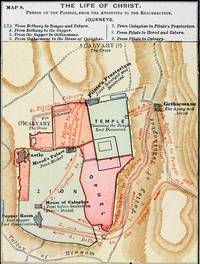 The Life of Jesus, Map 8: The Last Week in Jerusalem